Freediving holidays: what a first course involves and where to take one
An entry-level freediving course takes two to three days and certifies you to between 10 and 20 metres on one breath. You learn breath-hold breathing, Frenzel equalisation, line work and buddy rescue, and are asked for a static hold of 90 seconds to two minutes. What makes a destination suitable is warm, deep, current-free water close to shore.
Almost everyone who asks us about this is already a scuba diver. They have watched somebody drop past them down a line, come back two minutes later looking unbothered, and want to know what is involved. It is a different sport happening in the same water, and a first course has more in common with a set of driving lessons than with a week of fun dives.
What a first course actually teaches you
The syllabus splits four ways: theory, static breath-holds, horizontal swimming under water, and vertical dives on a line. Two to three days is normal, and AIDA’s own standard asks for at least three: roughly three hours of classroom time, two or three confined-water sessions and at least two open-water sessions.
The theory is physiology — the mammalian dive response, residual volume, why the urge to breathe comes from rising carbon dioxide rather than falling oxygen, and why hyperventilating beforehand strips out the warning signal without adding any useful oxygen.
In the water you learn a breathe-up, a duck dive that gets you head-down without splashing, and recovery breathing on surfacing. Static apnea is done face-down in shallow water with a buddy giving a tap signal every fifteen seconds; dynamic apnea is horizontal, in bifins, along a pool or a flat sandy bay. Depth work happens on a weighted line under a buoy, with a lanyard clipping you to it — free immersion first, then constant weight, where you fin.
Equalisation decides how the week goes. The Valsalva that scuba divers use works poorly head-down, because the lungs are compressing and the breathing muscles have less to push with. Freedivers learn Frenzel instead, moving a small volume of air with the tongue and larynx, which is good for 30 to 40 metres with practice. It is where most people stall on day two, and nobody plateaus because their lungs are the wrong size.
Then rescue: a session towing a limp buddy up from depth, removing their mask and doing blow-tap-talk until they breathe. Every school will also want a signed medical statement and some evidence you can swim, and that bar is lower than people fear: AIDA asks for 100 metres non-stop, Molchanovs for 200 metres, and PADI and SSI for adequate swimming and a short water-fitness check rather than a set distance.
Which agency, and does the badge matter
Four systems come up: AIDA, SSI, PADI and Molchanovs, with RAID and Apnea Academy behind them. All four teach the same physiology and the same rescue skills. What differs is the published numbers and the paperwork.
| Entry-level course | Static hold | Dynamic, in fins | Depth | Typical length |
|---|---|---|---|---|
| AIDA 2 Freediver | 2 minutes | 40 m | 12 m minimum, certified to 20 m | 3 days minimum |
| SSI Freediving Level 1 | About 1 min 30 | About 30 m | 10–20 m, certified to 20 m | 2 to 3 days, 16–20 hours |
| PADI Freediver | 1 min 30 | 25 m | 10 m minimum, certified to 16 m | 2 to 3 days |
| Molchanovs Wave 1 | 1 min 30 | 30 m | 12–20 m | 2 to 3 days |
Treat those as published minimums, not gospel: agencies revise standards, and a school will certify you at the shallow end of its range if that is where your ears stopped. Minimum ages differ more than the depths do — PADI and SSI both publish 12 as the floor for their entry-level freediver courses, and expect a parent to sign for anyone under 18, while AIDA asks for 18, or 16 with a guardian’s signature.
The cards are largely interchangeable, so the question is not which logo but which school — and the questions there are unglamorous. Students per instructor on a depth day. Whether there is oxygen on the beach. Whether every student gets a lanyard, and whether the line carries a counterballast that can bring a diver up if the instructor cannot.
What kit you need on day one
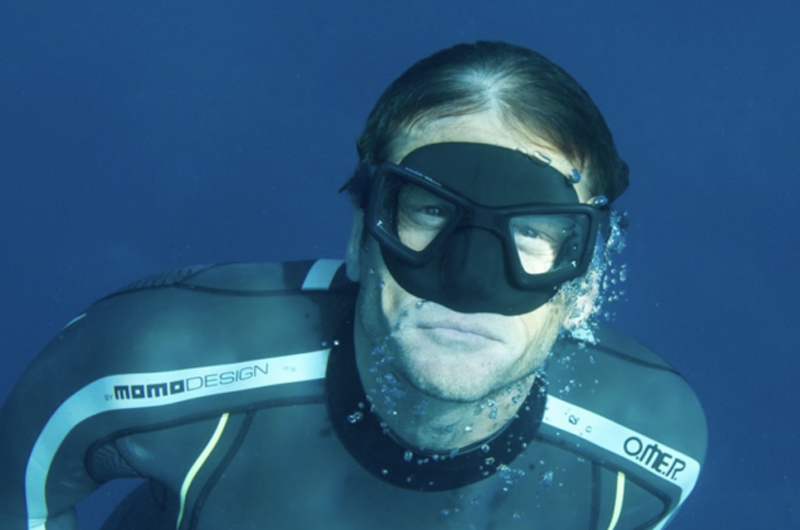
Almost none of your own: schools supply the lot, and you should let them. You will be handed long, soft bifins, a low-volume mask that takes less air to equalise, a rubber weight belt on the hips, and an open-cell wetsuit with no zip that goes on with soapy water. Open cell seals to the skin, so it is warmer than a scuba suit of the same thickness — 3 mm for the mid-20s, 5 mm and a hood around 22°C.
What makes somewhere a good place to learn
Five things, roughly in this order. Warm water, because below about 24°C you are cold by the third descent, and cold makes you tense, and tension costs oxygen. Deep water within a few minutes of a sheltered entry, so the line is not a boat ride away. Little or no current, because a line streaming off at an angle is unusable at this level. A pool or a flat shallow bay for the static and dynamic work. And a school with a proper setup: buoy, marked line, lanyards, counterballast, oxygen.
Notice how little of that is about reefs. A depth session is you, a rope and blue water. It is why we steer people towards particular islands and away from others when they ask about freediving holidays: the resort with the best house reef is often not the one with 30 metres of still water off the jetty.
Where the water actually suits it
Dahab, on the Gulf of Aqaba, is the default answer and deserves to be. The Lighthouse, in the middle of town, is where the schools do their beginner work: a sandy shore entry metres from the road that shelves gently, deep water a short swim out and next to no current — exactly the geometry a training line wants. The Blue Hole a few kilometres north is the deep end of the same coast, and the usual line about it needs correcting. At a little over 100 metres it has a grim reputation among scuba divers, but freedivers use it constantly, precisely because that depth sits straight off the shore with no current across it. It is where the schools hang their deep lines and where the experienced crowd goes; it is not where a first course happens. The sea runs about 22°C at its coldest, in February and March, and 27 to 28°C at the end of summer, and spring and autumn are the most comfortable months either side of that. The town is a windsurfing spot as well as a diving one, so depth sessions tend to be scheduled early, before the breeze builds. Gatwick to Sharm el-Sheikh is around five and a half hours, then 90 km up the coast by road.
One caveat there is ours rather than Dahab’s: we do not package Dahab itself. Our Egypt programme runs from Sharm el-Sheikh, El Gouna, Soma Bay, El Quseir and the Marsa Alam coast, and it is not the case that the rest of the country is boat-only — several of the Marsa Alam house reefs shelve into deep water straight off the beach, which is the same geometry with a shorter walk. Tell us which coast appeals and we will tell you what is bookable in your week.
Malta and Gozo is the short-flight version: three and a quarter hours from Gatwick, deep water straight off the rocks, and a tidal range measured in centimetres. The cost is temperature. The sea sits at about 15°C in February and March and reaches 26°C only in August and September, which makes a first course here a June-to-October proposition unless you are content in 5 mm and a hood. It pairs well with a scuba week, and our notes on the wrecks off Malta and Gozo cover the other half of that trip.
The Maldives gives the most forgiving water here, 28 to 30°C year round, with outer reef walls that drop steeply close to a lot of islands. The catch is that the channels between atolls run real current, and freediving instruction is resort by resort rather than a given, so the island has to be chosen for it. Getting there is about ten and a half hours to Malé plus a seaplane, which flies in daylight only, roughly 06:00 to 16:00, so a late arrival costs a night near the airport. If others in the party are scuba diving, our comparison of Maldives liveaboards against resorts is the place to start.
Mauritius is the one we usually talk people out of for a first course, and it has nothing to do with the diving: the island sits inside a barrier reef, so the deep water is beyond a pass and every session needs a boat. The sea is 23 to 24°C in August and 27 to 29°C in January and February, cyclone season runs November to April, and it is close to twelve hours direct from Gatwick. It suits one person taking a course while the rest of the party does something else, which is a week we sell a great deal of — it is just not a week built around a rope.
How it fits alongside a scuba week
Badly, is the short answer, and worth knowing before you book a trip that tries to do both.
Breath-hold diving after scuba is the combination to avoid. You surface carrying dissolved inert gas, and breath-hold descents put you back through pressure changes and add exertion on top, which is how a quiet bubble becomes a symptomatic one. The conservative guidance taught on freediving courses is to leave 12 hours after a single scuba dive and 18 hours after deep or repetitive scuba, and to apply the same figures in the other direction. The blunter version, and the one most dive medics give, is to keep meaningful freediving and compressed-gas diving on separate days entirely.
Freediving first and scuba later is the lower-risk order. The mild version of it (two or three relaxed descents to no more than 12 to 15 metres) is generally treated as tolerable with a surface interval of an hour or so before you get on a tank, with anything deeper or harder moved to another day. A course is not the mild version.
So for seven nights, block it: course on days one to three, scuba from day four, or the reverse with a clear day between. And leave the last day dry. Give yourself a clear day between your last deep freedive and the flight home, and note that the no-fly clock does not stack: DAN’s intervals — 12 hours after a single no-decompression dive, 18 hours after repetitive or multi-day diving — run from your last dive of either kind, so it is the longer window that sets your last wet day, not the sum of the two.
The risks, stated plainly
Freediving is safe under supervision and dangerous without it, and the gap is not a matter of degree.
Hypoxic blackout, the thing that kills freedivers, arrives without a warning sensation: for most healthy people the first sign of low oxygen is a greyout or unconsciousness. It usually happens in the last part of the ascent, often within the top three metres, or at the surface seconds after the first breath. The body helps for a while, closing the airway in a laryngospasm. Then the laryngospasm relaxes.
A diver who blacks out with a buddy watching is normally back on the surface and breathing within seconds. The same diver alone drowns. That is why a course teaches one up, one down, why the surfacing diver is watched for at least 30 seconds, and why the safety buddy has to be rested rather than sorting out their own breathing.
Now the part people skip. Practising breath-holds alone (hotel pool, bath at home, the resort’s swim lane before the instructor turns up) is the commonest way people are hurt by this sport. Dry tables on a sofa are fine; in water, on your own, they are not. The duller injuries are more frequent: ear and sinus damage from forcing Valsalva head-down, and lung or trachea squeeze from adding depth faster than the chest adapts.
Who this isn’t for
If what you want is to look at reefs while holding your breath, do not book a course. A depth session is a rope in blue water with nothing to see, and three days of that is training, not sightseeing. What you actually want is a snorkelling week at a resort with a good house reef, and perhaps one supervised try-freediving session so you can get to eight metres comfortably. We can book that just as readily, and it is a better week than a certification you never use again.
If the trip is about scuba progression (more dives logged, a nitrox card, your first 30-metre wreck) a course will eat three days and then, because of the surface-interval problem, cost you scuba days on top. Book the scuba week instead. If nobody in the party is certified yet the decision is easier still: a learn to dive holiday gets two of you into the water together on day one, and freediving will keep until a later trip.
And if you have already settled on the number you are going to hit, this is a bad sport to arrive at with a target. Depth at this level is set by your ears rather than your ambition, and plenty finish a first course certified at 12 metres rather than 20, because that is where equalisation stopped that week. Anyone who reads that as failure will push, and pushing is what hurts people.
Who it does suit: scuba divers curious about what their body does without a tank, swimmers comfortable being upside down in deep water, and anyone drawn to getting quietly better at one thing over several years. If that sounds like you, a week built around a course on Gozo between June and October, or in the Maldives if you would rather not plan around a calendar at all, is a sensible first move, and you will come home a calmer scuba diver as a side effect.
Frequently asked questions
Do you need to be a scuba diver before learning to freedive?
No, and the two are separate qualifications with separate skills. Non-divers often progress faster, because scuba divers arrive with a Valsalva equalisation habit that works badly head-down and has to be replaced with Frenzel. What schools ask for is more modest than people expect: AIDA wants 100 metres of non-stop swimming, Molchanovs 200 metres, PADI and SSI a short water-fitness check, and all of them a signed medical statement. Confidence matters far more than fitness at this level.
Can you freedive and scuba dive on the same day?
Not sensibly, and the order matters. Freediving after scuba is the combination to avoid, because you are carrying dissolved gas and breath-hold descents add pressure changes and exertion on top of it. The conservative guidance taught on freediving courses is to leave 12 hours after a single scuba dive and 18 hours after deep or repetitive ones. Freediving first is the lower-risk order, and two or three relaxed descents to 12 to 15 metres with an hour on the surface before a tank dive is about the limit of what instructors will wear. A course goes well beyond that, so alternate days.
How deep will I actually get on a beginner freediving course?
Somewhere between 10 and 20 metres, and your ears decide it rather than your fitness. AIDA 2 asks for 12 metres and certifies to 20, PADI Freediver starts at 10 and caps at 16, and SSI Level 1 and Molchanovs Wave 1 sit in the same band. Most people who stall do so because Frenzel equalisation takes longer to learn than three days allows. Finishing certified at 12 metres is an entirely ordinary outcome.
Is freediving actually dangerous?
Supervised, it has a good safety record. Unsupervised, it kills people who were fine a minute earlier. Hypoxic blackout gives most healthy divers no warning sensation at all, and typically happens in the last few metres of the ascent or in the seconds after surfacing. A buddy watching from the surface usually has you breathing again within seconds; alone in a hotel pool, nobody notices. Never practise breath-holds in water on your own.
Where is the best place to learn to freedive?
Dahab in Egypt is the usual answer: a sheltered shore entry with deep water a short swim out, little current, and a sea between roughly 22 and 28 degrees depending on the month, about five and a half hours to Sharm el-Sheikh plus an hour and a half by road. We do not package Dahab itself, so the versions we book are Gozo, three and a quarter hours from Gatwick but only warm enough from June to October, and the Maldives, which holds 28 to 30 degrees all year.
Planning your first freediving course abroad
Tell us your dates, whether anyone else in the party is scuba diving, and how you get on with equalising. We will say which school and which week fits, and whether Gozo, the Maldives or the Red Sea is the better buy.
Free, with no obligation and no booking fee. We’re a UK dive tour operator, trading since 2001 —
every resort and liveaboard we sell has been dived by one of our own team. Mon–Fri, 09:00–18:00 UK ·
ATOL protected (T7314) and Travel Trust Association members.