A Maldives liveaboard suits divers who want three or four dives a day, channel diving in current, and access to atolls no resort boat can reach in a morning. A resort island suits divers travelling with non-divers, nervous divers, families, and anyone who wants the day to slow down between dives.
What a liveaboard week actually looks like
Most boats run seven nights, boarding and finishing in Malé. The rhythm is tighter than people expect: a wake-up call before sunrise, a briefing on the back deck, the first dive going in while the light is still low, breakfast afterwards. Two more dives through the day, sometimes a night dive, and the boat moving between sites during surface intervals.
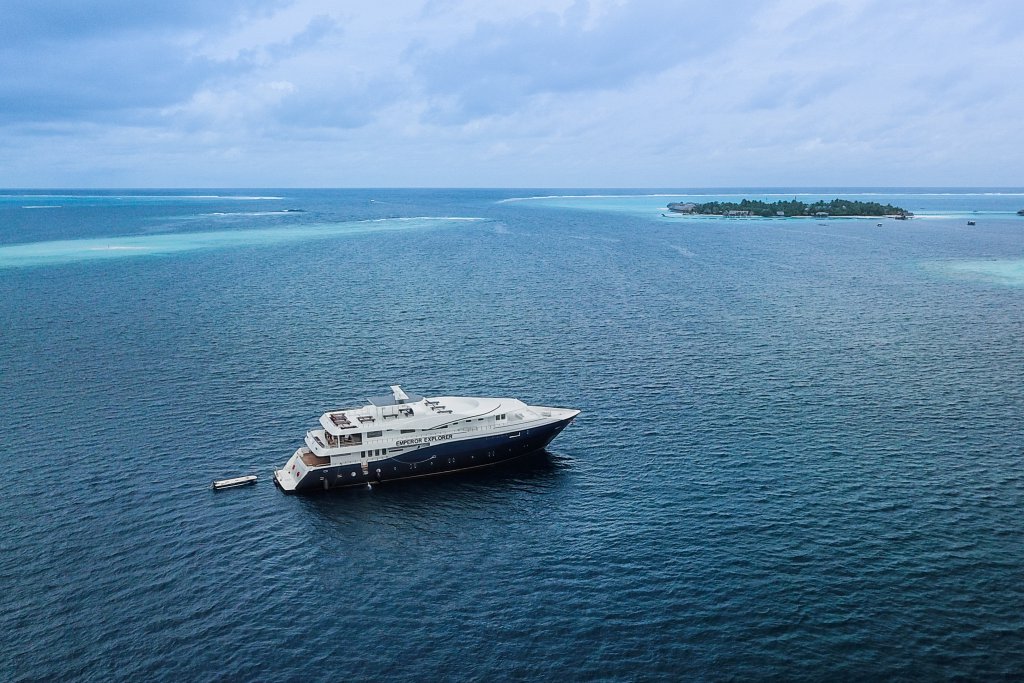
The detail that surprises first-timers is the dhoni. Almost every Maldivian liveaboard runs a second wooden vessel alongside carrying the tanks, the compressor and your kit. You dive from the dhoni and live on the main boat, so the wet, diesel-smelling half of the operation stays off the deck where you eat and sleep. It also lets the dhoni drop you upcurrent at a channel mouth and collect you wherever you surface – the whole reason channel diving works here.
The other difference is who picks the sites. The cruise director reads the tides each morning, so you may be told at breakfast that the plan has changed. That is a good sign: it is the flexibility you are paying for, and the thing a resort dive centre cannot do.
What you give up by sleeping on a boat
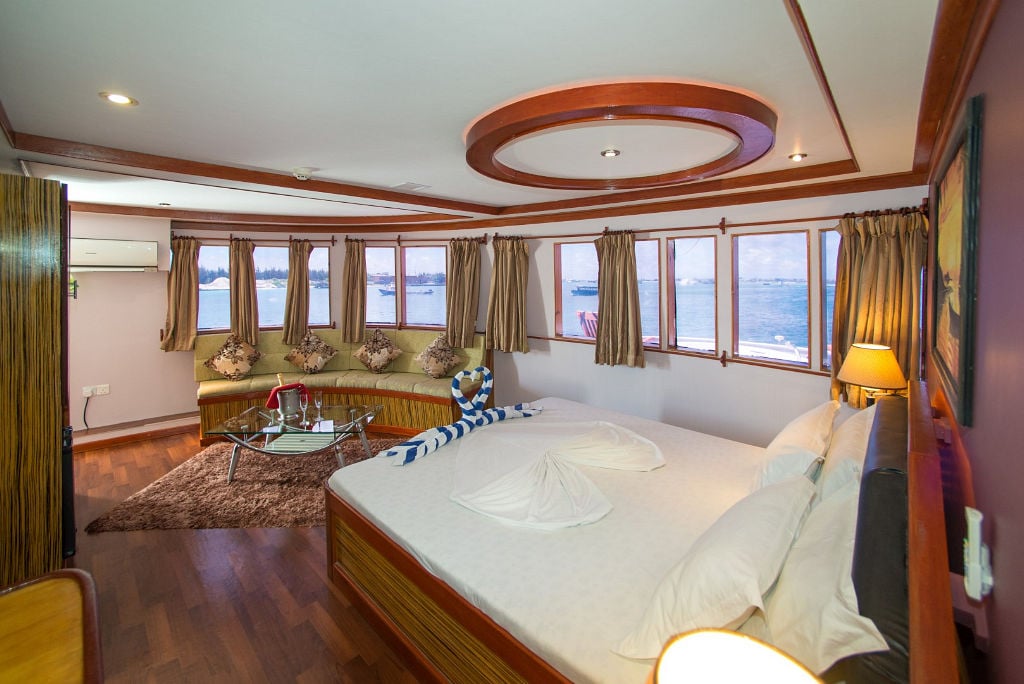
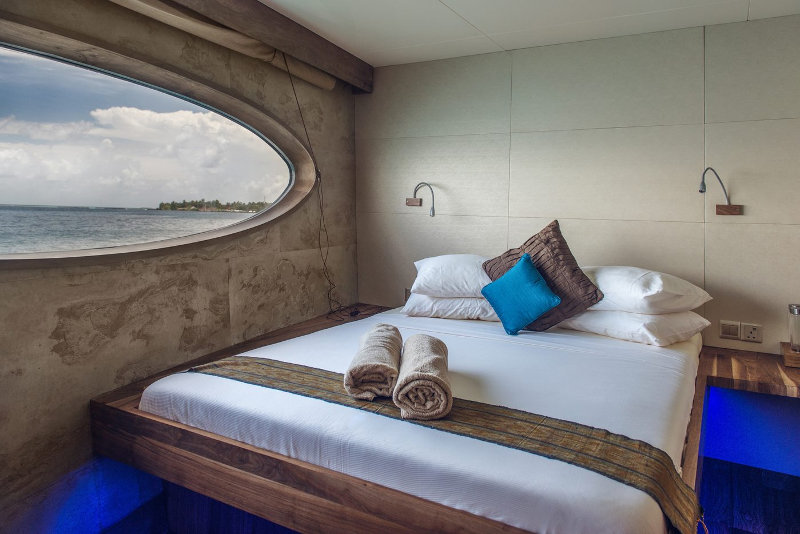
Space, mostly. Cabins are small and you live out of a bag for a week. You cannot choose your company – if the group does not gel, there is nowhere else to be. Connectivity is patchy, and you eat what the galley cooks, when it is served.
Movement matters more than people admit. Inside the atolls it is generally calm, but crossings between them are often done overnight and can be lively – a week is a long time to discover you get seasick.
How much of the Maldives you actually reach
This is the honest case for a boat. The atoll chain runs several hundred kilometres north to south, with 26 natural atolls along it. A resort dive centre works a fixed set of sites within about an hour’s boat ride of one island. It does them very well – but that is the same water, week after week.
A boat crosses atolls. The standard central route takes in North and South Malé, Ari and Vaavu, where most people first meet Maldivian channel diving and the whale sharks of South Ari. Routes reaching the far north or deep south need a domestic flight to join or leave. Read the Maldives liveaboard itineraries side by side before you fix on dates, because the route determines the diving far more than the boat does.
Season shapes it too, and not through temperature – the water stays warm all year, broadly in the high twenties Celsius. It is about which side of the atolls the plankton is on. In the southwest monsoon, roughly May to November, the eastern sides feed and mantas gather, including at Hanifaru Bay in Baa Atoll – snorkel-only under ranger supervision, so nobody can sell you a scuba dive there. In the northeast monsoon, December to April, visibility is generally at its best.
Currents, channels and whether drift diving suits you
Maldivian diving is largely channel diving. You drop into blue water at the mouth of a kandu, descend quickly and hook onto dead reef at the lip while the incoming current pushes clean water past you. Grey reef sharks, eagle rays and schooling jacks hold in that flow, and then you unhook and drift inside with it. Currents run strongest around the full and new moon.
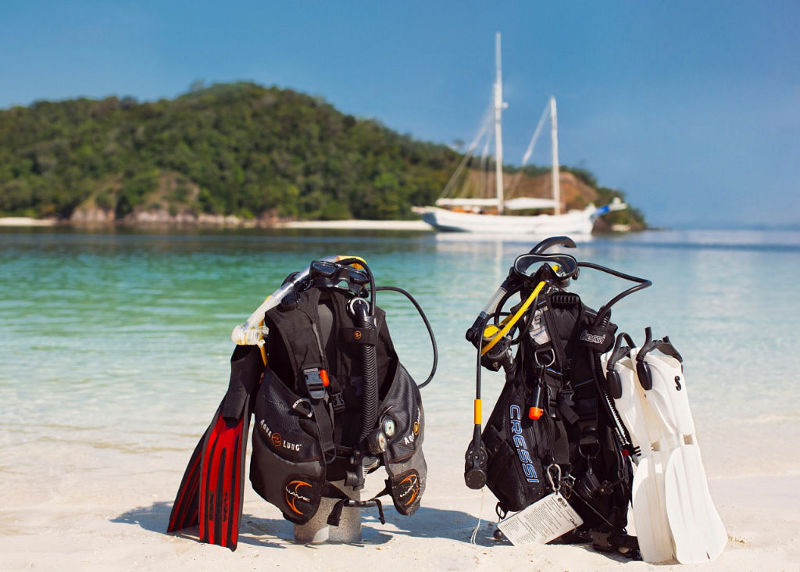
Two things follow. A reef hook is not optional kit, and most boats set an experience floor – commonly Advanced Open Water and a fair number of logged dives, though it varies. If moving water makes you anxious, understand that this is not one dive in seven here. It is the diving.
How the cost breaks down
The two prices are not comparable as printed, and this is where most people get it wrong. A boat price is close to all-in: cabin, all meals, usually three dives a day, guide. A resort nightly rate is a room. Diving is billed per dive on top, with equipment hire, green tax, and a transfer that can be substantial – a seaplane, or a domestic flight and speedboat, costs the same whether you stay four nights or ten.
So compare cost per dive, not cost per night. A boat week usually wins that arithmetic; a resort week wins on everything you do when you are not underwater. Both are true.
| Liveaboard week | Resort island week | |
|---|---|---|
| Dives in a typical week | Around 15–20, night dives included | Around 8–12, usually two a day |
| Sites available | Several atolls; route follows the tide | Fixed set within about an hour by boat |
| House reef before breakfast | No | Yes, on most islands |
| What the headline price covers | Cabin, all meals, most diving | Room and board; diving billed per dive |
| Transfer cost | None beyond Malé on central routes | Seaplane or domestic flight, fixed cost |
| Non-diving partner | Very little to do | Beach, spa, snorkelling, excursions |
| Missing a day | You sit on the boat | You have an island |
| Suits divers with | Solid buoyancy, current experience | Any level, including first-timers |
Who is better off on a resort island
Plenty of good divers, and we say so regularly. If you travel with someone who does not dive, a boat is a week of them waiting for you; the Maldives resort islands we book have enough above water that both of you get a holiday. The same applies with children – most liveaboards are not set up for them, and an island is the sensible base for a family dive holiday.
If you are learning, a resort wins outright: calm lagoon, a house reef to practise on, no pressure to keep pace with a boat schedule. It is why we point most people asking about a learn to dive holiday at an island. Photographers often prefer one too – reshooting one reef on four mornings beats a single pass at twenty sites.
Who this isn’t for
If your priority is the most dives for the smallest budget, the Maldives is not the answer and we would rather say so now. A Red Sea week delivers more dives per pound, and the Egypt liveaboard itineraries cover wrecks and reefs at a price the Maldives does not match. From dry land, Marsa Alam puts good reef within reach of a shore entry.
If macro is what you love – nudibranchs, pygmy seahorses, muck – the Maldives will underwhelm you. It is big blue, big animals and hard current. Bali and the wider Indonesian archipelago give you far more on a single dive.
And if hooking into current at dawn sounds like work rather than a holiday, say so before you book. Maldives liveaboard diving rewards divers who are comfortable being moved by water and slightly bored by calm reef. Everyone else has a better week on an island, and we would rather book you the right one than the impressive one.
Frequently asked questions
Is a Maldives liveaboard worth it compared with staying at a resort?
It is worth it if diving is the point of the trip. You get three or four dives a day instead of two, several atolls instead of one island’s fixed set, and a route that moves with the tide. It is not worth it if you are travelling with a non-diver, want a day off mid-week, or would rather the holiday slowed down between dives.
How many dives do you get on a Maldives liveaboard week?
Most boats run three dives a day with the occasional night dive, so a seven-night trip usually lands somewhere around 15 to 20 dives, depending on the route, the weather and how many you choose to sit out. A resort dive centre typically runs two boat dives a day, plus the house reef if the island has a good one.
Do I need to be an experienced diver for the Maldives?
For a liveaboard, usually yes. Most boats ask for Advanced Open Water and a fair number of logged dives, because channel diving in current is the core of the week rather than an occasional extra. On a resort island you can learn from scratch and dive sheltered sites and the house reef at your own pace.
When is the best time to go, and does it change the boat-or-resort answer?
The water is warm all year, so this is about plankton and current rather than temperature. The northeast monsoon, roughly December to April, generally gives the best visibility; the southwest monsoon, roughly May to November, feeds the western sides and brings mantas, including to Hanifaru Bay in Baa Atoll, which is snorkel-only. A boat can move to whichever side is working that week. A resort cannot.
Can non-divers or children come on a Maldives liveaboard?
Some boats will take them, but it rarely works well. A non-diver spends the week waiting on a small vessel with nowhere to go, and most liveaboards are not set up for children in terms of space, supervision or catering. If the group is mixed, a resort island is almost always the better base.
Talk to us before you pick a Maldives boat or island
Tell us how many dives you want, who is travelling with you and how you feel about current, and we will say which of the two we would put you on – including when the honest answer is neither. We have dived both sides of this, and we are ATOL protected (T7314) and members of the Travel Trust Association.
Free, with no obligation and no booking fee. We’re a UK dive tour operator, trading since 2001 —
every resort and liveaboard we sell has been dived by one of our own team. Mon–Fri, 09:00–18:00 UK ·
ATOL protected (T7314) and Travel Trust Association members.