Yes, you can qualify inside a normal week away: a PADI Open Water Diver course takes three to four days. It runs five theory sections, five confined-water sessions and four open-water dives, and certifies you to 18 m worldwide. A try dive takes half a morning and certifies nothing. Warm, shallow, sheltered water makes every part of it easier.
Learning abroad is not a compromise. A first regulator breath is easier at 27°C in a sheltered bay than in a UK quarry in March, where the water is still in single figures, and you finish with four sea dives rather than four dives in cold green water. What people underestimate is how much of the week it takes.
How much of your holiday a course takes
Budget three to four days. A normal schedule is theory and the first pool session on day one, the rest of the pool work plus open-water dives one and two on day two, dives three and four on day three, with day four as the weather buffer most centres quietly build in. Sessions run from about 09:00 to early afternoon, so your afternoons survive. Your mornings do not.
Two things shorten it. Doing the theory online before you fly takes 10 to 15 hours at home and removes most of a day in resort. Doing the theory and the pool work at a UK centre, then only the four open-water dives abroad (a referral) cuts the in-resort part to about a day and a half, and the referral paperwork stays valid for twelve months, so the trip can be booked to suit the calendar rather than the course. When we quote learn to dive holidays we put the course in the calendar first and build the week around it, otherwise people end up rushing dive four.
One rule outranks the rest: your last dive should be at least 18 hours before the flight home, and 24 is the sensible margin after several consecutive days in the water. A course ending the afternoon before a morning departure does not work, and a good centre will refuse it.
What the Open Water Diver course actually involves
Three parts, in order. Knowledge development is five sections of theory, each with a quiz, then a 50-question exam passed at 75 per cent. Not hard, but real content: pressure and volume, air consumption, ascent rates, how to read a dive computer.
Confined water is five sessions in a pool, or in shallow sea calm enough to behave like one. You learn to clear a flooded mask, recover a lost regulator, remove and replace the mask underwater, share air and hold neutral buoyancy. The mask-off skill is the one that unsettles people, and it is better to know that in advance.
Then four open-water dives across at least two days. Dives one and two are limited to 12 m, dives three and four to 18 m, and you repeat the pool skills in open sea. Pass, and you can dive to 18 m anywhere in the world with a buddy and no instructor. The card does not expire. Your skills do: after six to twelve months out of the water, book a refresher.
Try dive, Scuba Diver or the full certification?
These are different products, and centres are not always clear about which one you have bought. A try dive is an experience. A certification is a licence.
| Route | Time it takes | Depth limit | What it lets you do afterwards | Who it suits |
|---|---|---|---|---|
| Discover Scuba Diving (try dive) | Half a day, sometimes under three hours | 12 m, usually much shallower on a first attempt | Nothing on its own; one dive may credit towards the full course | Anyone still deciding whether they like being underwater |
| PADI Scuba Diver | About two days | 12 m | Dive only in the company of a dive professional; upgrades later | Short breaks, and nervous starters who want less pressure |
| Open Water Diver | Three to four days | 18 m | Dive with a buddy, hire kit and book dives worldwide | Almost everyone learning on a week’s holiday |
| Open Water by referral | One and a half to two days in resort | 18 m | Exactly the same card; theory and pool are done at home first | Short trips, and couples where only one is learning |
| Advanced Open Water (afterwards) | Two days, five dives | 30 m | Deeper sites, night and drift dives, most liveaboard itineraries | Your second dive trip, not your first |
How old you have to be, and how deep they can go
Ten is the age for a real course. From 10 a child can take Junior Open Water Diver, in two bands: 10 and 11-year-olds are limited to 12 m and must dive with a professional or a certified parent; 12 to 14-year-olds can go to 18 m, still with a certified adult. At 15 the junior card converts to a full Open Water Diver. Ten is also the minimum for a try dive.
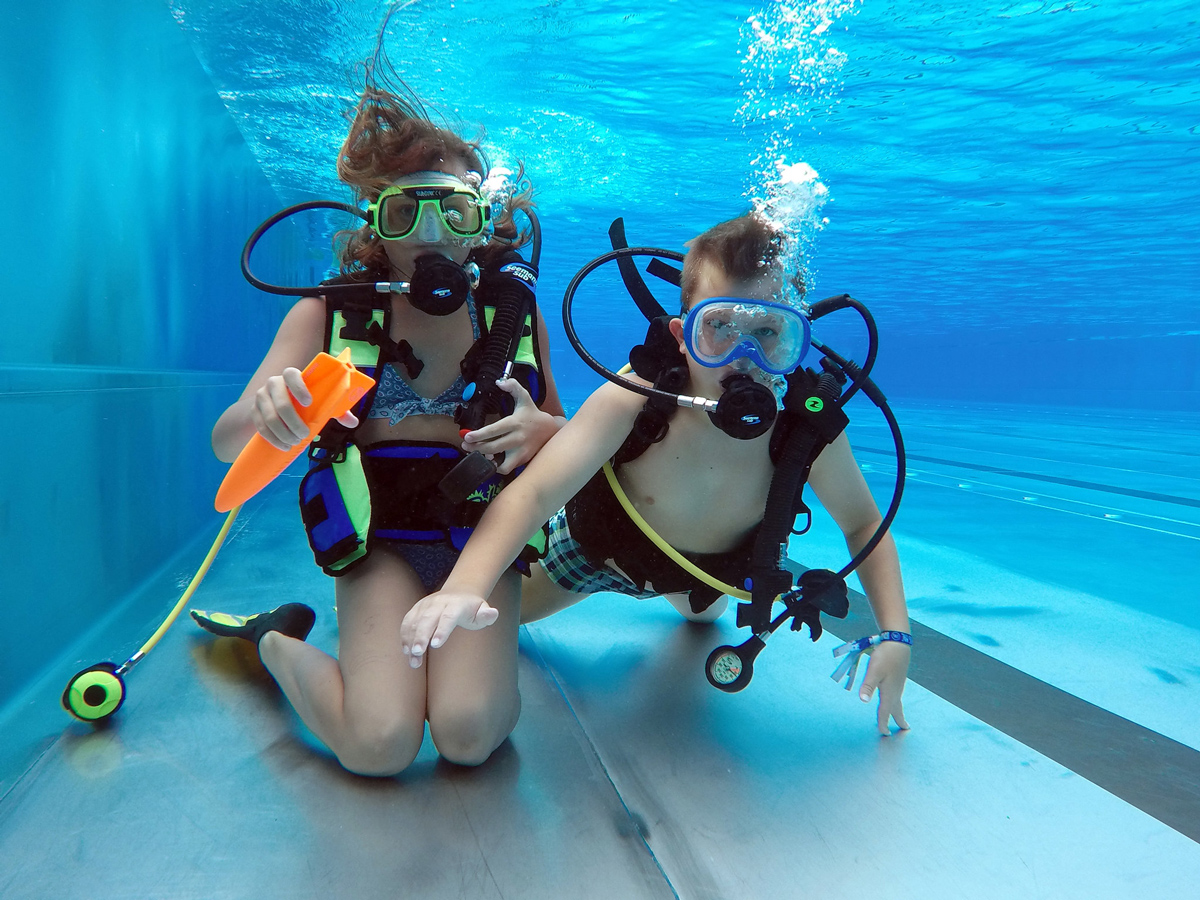
Below that, the pool options are real but limited. Bubblemaker takes children from eight to a maximum of 2 m, and it is a session rather than a qualification. That difference shapes the planning: on a family dive holiday an eight-year-old can be in the water and enjoying it, but only the tens and over are coming on the boat.
The medical form, and what needs a doctor
Everyone signs the standard diver medical questionnaire before the first session: ten questions plus supplementary boxes. Tick yes to anything and a doctor has to sign you off before you get in the water. The usual triggers are asthma or recurrent chest problems, heart conditions and blood-pressure medication, diabetes, epilepsy or blackouts, recent surgery, ear or sinus surgery, some psychiatric medication, and being over 45 with additional risk factors. Pregnancy is a straight no.
Do this at home, six weeks before you fly. UK GPs are not obliged to provide diving medicals on the NHS and most charge a private fee, and the UK Diving Medical Committee publishes a list of approved referees if your own surgery will not. We see the alternative every season: someone ticks one honest box at the dive centre desk and loses three days finding a doctor abroad. A heavy cold stops you too, because you cannot equalise blocked ears — that one is a delay, not a cancellation.
PADI, SSI or BSAC — does the agency matter?
Less than the internet suggests. PADI, SSI, BSAC, SDI and RAID all certify entry-level divers to the same international standard, and every one of those cards is accepted worldwide. PADI has the largest network, so follow-on courses are easiest to find anywhere. SSI works through affiliated centres, usually includes its digital materials, and allows a more flexible skill order. BSAC is the UK club route: Ocean Diver runs over several weeks at a club pool, certifies to 20 m, introduces rescue skills earlier and costs less because volunteers teach it — but it is not a holiday. What actually varies is the instructor and the class size. Ask how many students share one instructor in open water: eight is the standards ceiling for an instructor working alone, and only a certified assistant alongside lifts it past that, so four is comfortable and two is better than any logo.
Where a first course genuinely works
The criteria are unglamorous. Water warm enough that nobody shivers through skill practice (the mid-twenties in a 3 mm suit, or a couple of degrees cooler in a 5 mm) a shallow sandy entry or a pool, sheltered conditions, short boat rides or none, and a centre big enough to run a course while your partner dives. Egypt meets all of it better than anywhere within a six-hour flight. Diving holidays in Egypt run year-round, with water around 22°C in February and March, which is a 5 mm-suit month rather than a shorty month, and touching 29°C in late summer, and the training shallows at El Gouna are about as forgiving as open sea gets.
Soma Bay, roughly 45 km south of Hurghada and under an hour from the airport, is the base we suggest most often. The bay is a large shallow sand flat with a house reef reached from a jetty: skills happen in waist-deep water, the reef is a fin-kick away, and nobody spends a morning on a boat feeling queasy before dive one. We compare the Egyptian bases in detail in our guide to the Red Sea dive bases.
Malta is the three-hour option, and it works from June to October, when the sea climbs from about 23°C in June to a peak near 26°C in August and September, and is back to about 23°C by late October. Training happens from sheltered rocky bays with steps into the water, visibility is often 20 m or more, and there is a real holiday around it. By February the sea is down near 15°C, which is fine in a proper suit and miserable for a beginner learning to clear a mask.
Mauritius works for a different reason (the lagoon inside its barrier reef stays flat when the ocean outside is not) though a 12-hour flight is a lot of trip to spend three days of in a training bay. What fails: an hour’s crossing to every site, reliable current or surge, cold water in a thin suit, and liveaboards, where a boat that moves every night cannot give an instructor the same shallows five sessions running.
If only one of you is learning
This is the planning problem people bring us most. The learner is occupied four or five hours a day for three or four days, which is a lot of a week. If the other half already dives, book a centre running guided dives on the same boat schedule, so you eat lunch together and dive separately. If they do not dive, pick a base with something else happening at the same hour: The Breakers in Soma Bay sits on a kitesurfing flat.
The referral route fixes it more directly, dropping the in-resort commitment to about a day and a half. And if the certified half wants their own reason to be there, choose the destination for them: Malta and Gozo hold enough wreck diving (scuttled tugs and ferries, a patrol boat, wartime aircraft sitting upright on the sand) to fill a week while you are still in the training bay.
Who this isn’t for
If your holiday is four or five nights, do not start the full course from scratch once you land. You will spend the whole break in a classroom, a pool and a training bay, then fly home. On a break that short the honest routes are the referral, with theory and pool work done at home and only the four dives abroad, or the two-day Scuba Diver card, or a try dive now and a proper course week booked for later. The same applies if the trip has one fixed highlight you have already paid for. Newly certified divers are limited to 18 m and to gentle conditions, and the site you came for is very likely outside both.
If you are not comfortable in water without a mask on your face, deal with that before you commit. The course includes a swim — 200 m in any stroke with no aids, or 300 m with mask, fins and snorkel if you prefer — and ten minutes of floating or treading water. Neither is timed and neither is hard for a competent swimmer, but they are not waived, and a local pool is a better place to find that out than a dive centre on day one.
And if what you want is depth, rescue skills and a diving community rather than a week away, a UK club is the cheaper way in: BSAC training costs less, goes a little deeper, and uses no annual leave. It is not either-or, though — plenty of club divers do the theory and the pool sessions at home and then spend their leave finishing the qualifying dives in warm water, which is the referral route under another name.
What is left is the large majority: adults and teenagers with a week to spend, no medical complications and a tolerance for being told what to do for three mornings. For them a course abroad is the fastest and warmest way in, and choosing the right base does most of the work — which is how we shortlist the resorts we use for first courses.
Frequently asked questions
Do you need to be able to swim to learn to dive?
Yes, though less than people fear. The entry-level course includes a 200 m swim in any stroke with no mask, fins or snorkel, or 300 m using mask, fins and snorkel, plus ten minutes of floating or treading water. Neither part is timed and there is no speed requirement. If you would struggle with either, spend a few sessions at your local pool before you fly rather than finding out on day one.
How old does a child have to be to learn to dive on holiday?
Ten for a genuine qualification. From 10 they can take a junior open water course, but 10 and 11-year-olds are capped at 12 m and must dive with a professional or a certified parent, and 12 to 14-year-olds are capped at 18 m and must dive with a certified adult. At 15 the card becomes a full adult certification. Children from eight can do supervised pool sessions to 2 m, which is fun but is not a qualification.
Do I need a medical certificate before a diving course?
Only if you tick yes on the standard questionnaire everyone completes. Asthma, heart conditions, blood-pressure or psychiatric medication, diabetes, epilepsy, recent surgery, ear or sinus surgery and being over 45 with other risk factors all need a doctor’s signature first. Arrange it at home about six weeks ahead. UK GPs are not required to do diving medicals on the NHS, so expect a private appointment, and the UK Diving Medical Committee lists approved referees.
Is a PADI qualification better than SSI or BSAC?
Not better, just different in delivery. All three certify entry-level divers to the same international standard and all three are accepted worldwide, so no centre will turn you away for holding the wrong logo. PADI has the biggest network for follow-on courses. SSI runs through affiliated centres and usually includes its digital materials. BSAC is a UK club route taught over weeks, cheaper and broader, but not something you complete on holiday.
How long after your last dive can you fly home?
Leave at least 18 hours between your final dive and take-off after several days of diving, and 24 hours is the margin we plan to. That single rule shapes the whole week: if you fly home on a Saturday morning, the 24-hour margin puts your last course dive on Thursday, and even the bare 18-hour minimum has you out of the water by Friday lunchtime. Tell the dive centre your flight time on day one and let them build the timetable backwards from it.
Not sure where to do your first course
Tell us who is learning, who already dives and when you can travel. We will match a centre and a resort to that, flag anything on the medical form early, and say so if a different destination would suit you better.
Free, with no obligation and no booking fee. We’re a UK dive tour operator, trading since 2001 —
every resort and liveaboard we sell has been dived by one of our own team. Mon–Fri, 09:00–18:00 UK ·
ATOL protected (T7314) and Travel Trust Association members.