Family dive holidays: what age children can start, and which destinations work
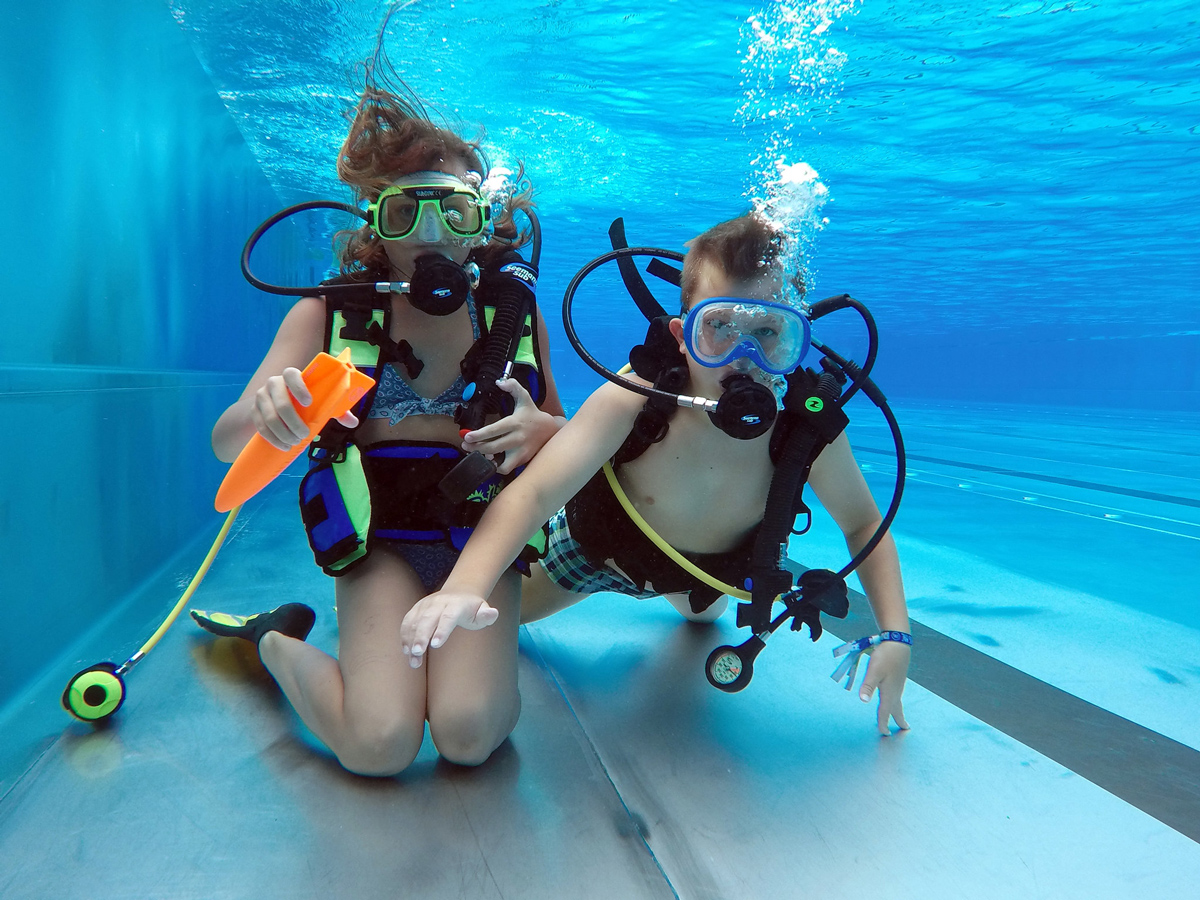
Most children can start scuba in a pool at 8 and qualify as junior divers at 10. Juniors aged 10 to 11 are limited to 12 metres and must dive with a certified parent or a professional; 12 to 14 year olds can reach 18 metres with any certified adult. The destination matters more than the training agency.
The families who ring us are rarely all divers. One parent dives and one does not, one child is old enough and one is not, and there is a fixed week in the school calendar it all has to fit inside. That is solvable by choosing the right place, not by pushing everyone through a course.
What age can a child actually start diving?
There is a ladder, worth knowing before you promise anyone anything. From 8, a child can breathe underwater in a pool. PADI’s Bubblemaker caps them at 2 metres under instructor supervision; Seal Team and SSI’s Scuba Rangers cover the same ages. None of these is a certification, and they run in a pool or in a roped-off patch of shallow water that behaves like one, never on a dive site. They are for finding out whether a child likes a regulator in their mouth, which you cannot predict.
From 10, they can do a supervised try-dive in open water and begin the junior entry-level certification. That course is the adult one: same theory, same skills, same four open-water dives. Only the card differs, and at 15 it becomes the full qualification. Agencies draw the line in different places — BSAC’s Ocean Diver begins at 12, though its shallower Discovery Diver takes children from 10.
Younger children snorkel, and that is not a consolation prize. A six-year-old on a shallow reef in a mask that fits usually has a better week than a ten-year-old talked into a course.
What a junior certification lets them do
Families get caught out here: the depth limit and the buddy rule are separate restrictions. A junior of 10 or 11 is limited to 12 metres and must be with a certified parent or guardian, or a professional. From 12 to 14 the limit is 18 metres and any certified adult can buddy them. At 15 both restrictions fall away. Junior advanced training starts at 12 and lifts the ceiling to 21 metres, adult buddy still required.
So if you are not certified yourself, your ten-year-old cannot dive with you: every dive must be bought as a guided dive with a professional. Across a week that is a real cost, and the one families most often fail to budget for. It is an argument for the non-diving parent qualifying before the family week rather than inside it: a learn to dive holiday of their own earlier in the year, or the theory and pool work at home and the open-water dives tacked on to a quiet couple of days.
That 12-metre ceiling rules out a lot of sites: most Mediterranean wrecks, the interesting part of many walls. A shallow, varied house reef is not a compromise for a junior diver; it is the only thing that works.
The forms to sort out before you fly
Two pieces of paper matter. The first is the diver medical questionnaire every diver completes before training. Any box ticked yes needs a doctor’s sign-off, and with children the usual triggers are asthma, ear grommets and some ADHD medication. Grommets rule diving out while they are in place; asthma often does not, but needs a doctor who understands diving. The UK Diving Medical Committee lists referees.
Get it done at home: finding a doctor abroad who will sign a form for a British child can cost you two days of a seven-day holiday. UK GPs normally charge for it, as it is not NHS work, and some decline it, so ask early.
The second is consent: anyone under 18 needs a parent or legal guardian to sign the training paperwork. Some centres want that signature witnessed at the desk; others take a form signed and scanned before you travel. If grandparents are taking the children, ask which the centre wants before you book, because those two answers lead to very different Monday mornings.
What actually makes a destination work for a family
Four things, in this order.
A short transfer. After a flight, an hour in a minibus is tolerable and three hours is not.
Shallow, sheltered water you can walk into. A house reef in 5 to 12 metres with no current changes the shape of the week: a twenty-minute dive becomes possible when that is all anyone has in them, and nobody is stuck on a two-tank morning they cannot leave.
A centre that teaches children regularly. Not one that can, one that does. Ask how many junior courses they run in a season and whether they hold small jackets and 10-litre cylinders. A child in an adult jacket on a 12-litre steel cylinder will be cold, over-weighted and miserable by the second dive.
A proper week for the people who are not diving. This one gets skipped, and it decides whether anyone repeats the trip. Most of the family dive holidays that go wrong do so because one adult spent seven days waiting on a jetty.
Four destinations, judged against those criteria
These are the four we come back to for mixed families. Not the four best dive destinations, which is the point.
| Destination | Flight from the UK | Transfer | Water a junior can use | For the non-divers | The catch |
|---|---|---|---|---|---|
| Soma Bay, Egypt | 5½ hours direct to Hurghada | About an hour | Shallow sandy bay, reef edge off a jetty; 22–28°C | Pools, kitesurfing, full resort facilities | Mid to high thirties on land in summer |
| Malta and Gozo | 3 hours direct, all year | 20–45 min; Gozo adds a 25-minute ferry | Sheltered bays, ladder entries over rock; 15–26°C | Valletta, Comino, boat trips, English everywhere | Only warm enough for children from July to September |
| Mauritius | 12 hours direct | 1 hour west coast, 75 min north | Flat lagoon inside a fringing reef; 23–28°C | Beaches, hotel kids’ clubs, inland trips | The flight length; August cooler and windier |
| Bonaire | None direct; a day via Amsterdam | 5 to 20 minutes | Reef from 5 m, gentle slope, no current; 26–28°C | Shore snorkelling, shallow windsurfing at Lac Bay | A diving island first; non-diving teens get bored |
Soma Bay is the one we book most for a first family trip: about an hour south of Hurghada airport, some 50 km down the coast, a large shallow sandy bay behind the hotels, and a reef edge reached from a jetty rather than a day boat. Water runs from about 22°C in February to 28°C in late summer. The rest of the Egyptian Red Sea coast works too, but much of it means a boat every morning, a long ask of a ten-year-old by day three.
Malta is the short-flight answer, and for teenagers often the better one: three hours from the UK, English an official language, no malaria, and a single hour of time difference, because Malta keeps central European time all year. The catch is temperature: 15 to 16°C in February and March, and a children’s proposition only from July to September, when the sea reaches 25 to 26°C. June and October sit nearer 22 to 23°C, which an adult in a 5 mm suit will shrug off and a ten-year-old will not. Entries are over rock, down ladders, in boots, which suits a confident 13-year-old better than a nervous 10-year-old.
The sites that make Malta interesting to adult divers are also the deep ones. The scuttled wrecks off Malta and Gozo mostly sit past 18 metres, several of them past 30. A parent diving with a junior spends the week on reefs, arches and caves instead.
Mauritius has the calmest family water of the four. A fringing reef encloses most of the island in a lagoon that is flat, shallow and warm (roughly 23°C in August, 28°C in February) and the hotels are set up for children in a way Red Sea dive hotels are not. The price is the flight: 12 hours direct, plus a transfer. Diving conditions are best from October to December and again in March and April, either side of the January and February cyclone peak rather than through it. With children, take the March to April window: the lagoon is still close to 28°C. Our guide to diving in Mauritius sets out that cyclone window in full.
Bonaire is the outlier. Nowhere else lets a certified family dive on its own timetable — tanks in the truck, park at the yellow stone, walk in. The reef starts at about 5 metres, runs 26 to 28°C all year and has almost no current on the sheltered west coast. Budget for the nature fee while you are at it: everyone aged 13 and over pays 40 US dollars for a calendar-year tag before they so much as snorkel, and under-13s go free. It is also a full travelling day from the UK, and an island where diving is the main event. For one diver travelling with three people who would rather be by a pool, it is the wrong call.
Which school holiday you are locked into
Most families cannot pick the month, so the question is which suits the week you are allowed. At Easter the Red Sea sits at about 23°C, which is workable but means a 5 mm suit and a hood for a child rather than a shortie, and Mauritius is coming out of cyclone season near 27°C, which does not. Malta at 16 to 17°C is not a children’s option at all. In late July and August Malta comes into its own at 25 to 26°C; Red Sea water is warmest but mid to high thirties on land means early dives and afternoons indoors, and Mauritius is in its cooler, windier winter at about 23°C. October half-term is the best of the three for the Red Sea, at around 27°C, and the worst of the three for Malta, which is back down to 22 to 23°C by then.
Children also lose heat faster than adults. Below about 26°C a shortie is not enough: a 5 mm suit, a hood and shorter dives keep a junior keen rather than cold.
What you can realistically get done in one week
An entry-level certification takes four or five days of a seven-day holiday: theory, pool sessions and four open-water dives. It does not compress well, because tired children fail skills that rested children pass.
Putting the whole family through it in the same week is the commonest planning mistake we see. If one person struggles with mask clearing, or picks up an ear infection on day two, the timetable collapses and the certified adults spend the week supervising instead of diving. Stagger it: one child certifies this year while the other does a pool programme, or a parent qualifies in a UK pool over winter and does the open-water dives abroad in two days. If you take that second route, check the dates: the referral paperwork is normally good for twelve months, so the pool half and the sea half have to fall inside the same year.
A more realistic week: a pool taster for the youngest, a junior course for the eldest, four or five unhurried dives for the adults, two days when nobody gets wet. That is the shape of most of the trips we put together for families, and the shape people rebook.
Who this isn’t for
If every child in the party is under 8, this is not the year for a course. Book the resort for the snorkelling and the shallow bay by all means, and come back for the tanks in a couple of years. Nothing sold as diving for under-8s is diving, and resort prices for a pool session they could have at home are poor value. Warm shallow water and a mask that fits will do more for a small child’s interest in the sea than an early tank. A family with a six-year-old and an eleven-year-old is a different question altogether, and it is most of what we book.
If you were hoping to combine this with a liveaboard, do not. Most boats set a minimum age of 12 or 15, several 18, and even where children are accepted the format is wrong: four dives a day, night dives, current, small cabins, and no way off if someone has had enough by Wednesday. Liveaboards suit a family of teenage divers who all want the same thing, and almost nobody else.
And if you are an experienced diver who wants this week to be about the diving (drift dives, deep wrecks, sharks, four dives a day) a family trip will not deliver it. Junior depth limits and a shallow sheltered house reef are not accidental; they are the reason the holiday works. Book that trip separately and enjoy both properly.
What it does suit is a family with at least one child of 10 or over, at least one certified adult or one willing to become one, and a week in a single resort where the water is warm enough that nobody is counting the minutes. Get those three right and the diving looks after itself.
Frequently asked questions
Does a parent have to be a certified diver for a child to dive?
For a 10 or 11 year old, effectively yes — the junior diver must be with a certified parent or guardian, or with a diving professional. If neither parent dives, every dive has to be bought as a guided dive with an instructor, which adds up quickly across a week. From 12, any certified adult can act as the buddy, so an aunt, an adult sibling or a family friend solves it.
Do children need a medical certificate to go scuba diving?
Only if the standard diver medical questionnaire flags something. Every diver completes it, and any yes answer needs a doctor’s sign-off before training starts. With children the common triggers are asthma, ear grommets and certain ADHD medications. Grommets rule diving out while they are in place; asthma often does not, but needs a doctor familiar with diving. Get the form signed in the UK before you travel, not at the resort desk.
Is a liveaboard suitable for a family with children?
Rarely. Most liveaboards set a minimum age of 12 or 15, and some 18. Beyond the rules, the format works against families: four dives a day, night dives, real current on many itineraries, cabins with no space, and no way to leave mid-week if a child has had enough. A resort with a shallow house reef gives you the option to skip a day, which on a boat you do not have.
Where is the best place to take children diving for the first time?
Somewhere with a short transfer, shallow sheltered water and a centre that teaches juniors every week. The Egyptian Red Sea covers all three and is about five and a half hours from the UK. Malta is a three-hour flight and works for children from July to September, when the sea reaches 25 to 26°C; June and October are nearer 22 to 23°C. Mauritius has the calmest lagoon water of the three but costs you a twelve-hour flight. Match the destination to your school holiday week rather than the other way round.
Can the whole family do an Open Water course in the same week?
You can, but it usually goes badly. The course takes four or five days of a seven-day holiday, and if one person struggles with a skill or picks up an ear infection, everyone’s timetable slips and the qualified adults end up supervising rather than diving. Staggering works better: one child certifies this year and another does a pool programme, or an adult completes the theory and pool work at home first.
Planning a dive week with children in tow?
Tell us your children’s ages, who dives and who does not, and which school holiday you are stuck with. We will suggest resorts with a shallow house reef and a centre that teaches juniors properly.
Free, with no obligation and no booking fee. We’re a UK dive tour operator, trading since 2001 —
every resort and liveaboard we sell has been dived by one of our own team. Mon–Fri, 09:00–18:00 UK ·
ATOL protected (T7314) and Travel Trust Association members.