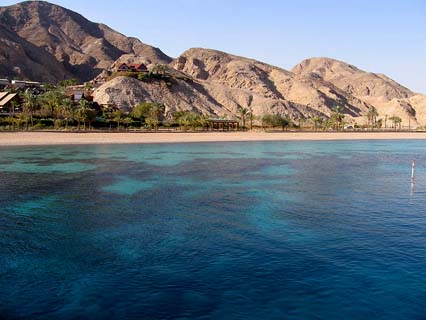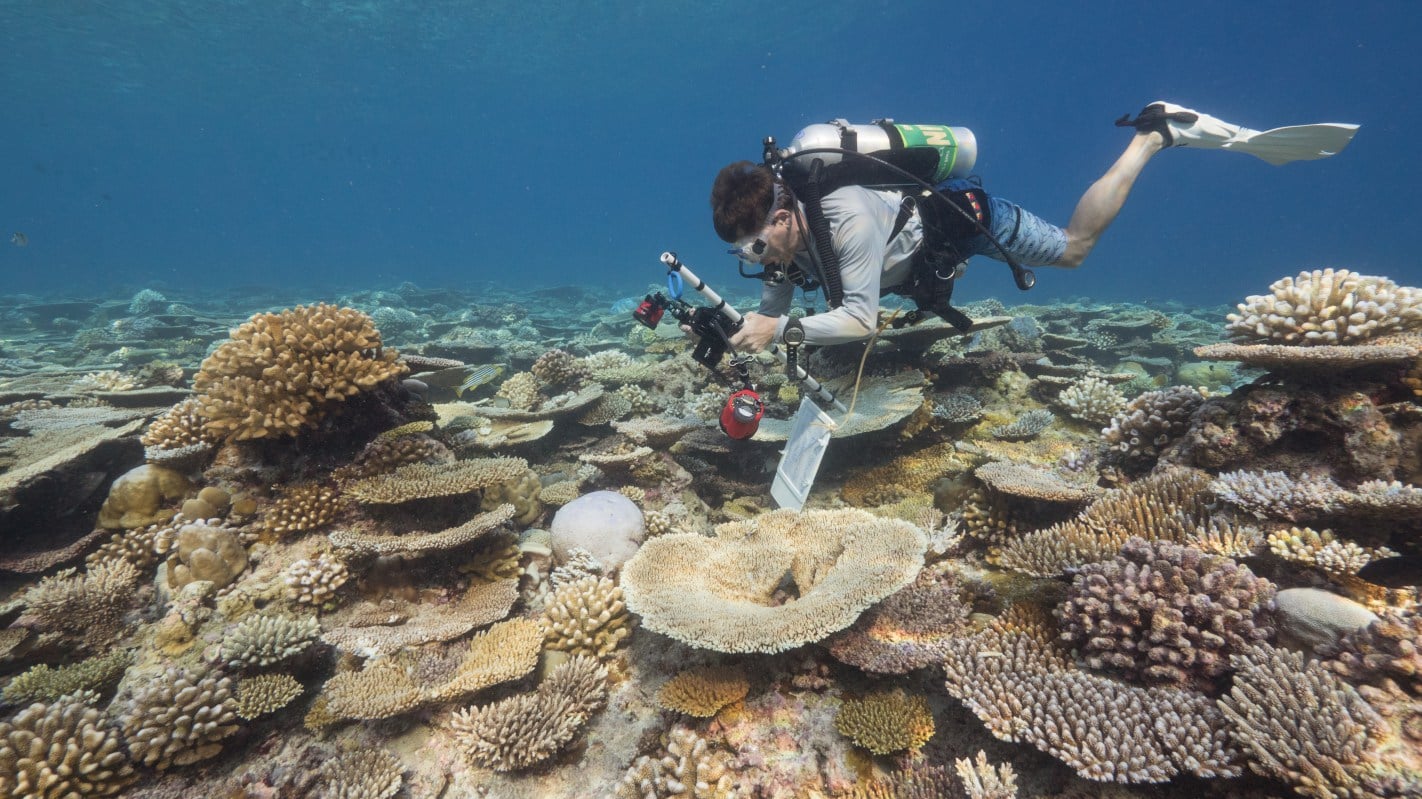
Little Cayman has the best diving of the three, Grand Cayman has everything else, and Cayman Brac sits between them. Bloody Bay Wall starts at about 6 m and drops past 300 m; Grand Cayman gives you the Kittiwake, Stingray City and walk-in shore dives; the Brac has the Tibbetts wreck and enough ashore for a rest day.
The three share a country, a currency and a reputation, and they are not the same holiday. Almost every disappointed Cayman trip we hear about is someone who booked the right country and the wrong island.
How different are the three, really
Grand Cayman covers 196 km² and holds around 75,000 people. Little Cayman lies about 120 km to the north-east of it, and Cayman Brac sits a further 8 km east again, which puts the Brac roughly 145 km from Grand Cayman. Between them the two small islands hold a little over 2,150 — Cayman Brac just under 2,000 at the 2021 census, Little Cayman 161. That gap explains most of what follows: the small islands are quiet underwater because nobody is there, and quiet ashore for the same reason.
| Island | Getting there | The diving | Ashore | Suits |
|---|---|---|---|---|
| Grand Cayman | International airport; no onward hop | Walls all round, the Kittiwake, Stingray City, a dozen shore dives | Hotels, restaurants, shops, beach, a capital | Mixed parties, first visits, anyone with a non-diver |
| Little Cayman | Grand Cayman, then a 35 to 40 minute Twin Otter hop; not a port of entry | Bloody Bay Wall and Jackson’s Bight — why serious divers come | One shop, a few restaurants, a nature reserve, a beach | Divers who want four dives a day and no distractions |
| Cayman Brac | Grand Cayman, then a similar hop, sometimes on a jet; a port of entry in its own right | The Captain Keith Tibbetts wreck, walls off both coasts | Just under 2,000 people, caves, climbing on the Bluff | Divers who want quiet water but not total isolation |
| Liveaboard | Grand Cayman, then straight to the boat | All three in a week, weather permitting; 24 to 27 dives | Nothing — you are on a boat | Divers whose measure is dives logged; no use to a non-diver |
What Grand Cayman is actually good at
This is the island that works when the party is not all doing the same thing. Seven Mile Beach — nearer 10 km than the 11.3 the name promises, since a generous measurement only gets it to 6.3 miles and the uninterrupted sand is closer to six — carries most of the hotel stock, and boats leave from piers along it and from George Town. If someone wants a beach, a shop or a restaurant that is not the hotel dining room, this is the only island of the three with them. Our Grand Cayman hotels are not all on that strip, and that matters: the diver-dedicated one sits on the George Town waterfront with its own boats and its own shore entry, and there is a quieter option out at East End for people who would rather not be on the busy side.
The signature dive is the USS Kittiwake, a 76 m Chanticleer-class US Navy submarine rescue ship put down about half a mile off the north end of Seven Mile Beach, alongside the Sand Chute site, on 5 January 2011. Tropical Storm Nate rolled it onto its port side in October 2017 and dragged it towards deeper water, which is why published depths still disagree; reckon on the sand at 20 m or a little more, and the shallowest structure somewhere between 10 and 14 m rather than the 4.5 m it used to be. Swimming a corridor sideways asks more of your buoyancy, and that drop in the shallowest point is what took the wreck out of snorkelling range.
Stingray City is two places with one name: the Sandbar in the North Sound, a metre of water where boatloads of people stand and hold southern stingrays, and a dive site nearby in 3.5 to 4 m. Both are hand-feeding operations rather than diving. Go once, on a weekday.
The walls are the real point. They run right round the island, the North Wall being the celebrated one, its lip generally between 12 and 18 m before it goes vertical. Shore diving is the other thing Grand Cayman has that the others do not — Cemetery Reef off Seven Mile Beach in 15 to 18 m, and Eden Rock and Devil’s Grotto off George Town in 6 to 15 m.
Why serious divers go to Little Cayman
Bloody Bay Marine Park runs along the north-west coast, taking in Bloody Bay itself and Jackson’s Bight next door. The drop-off begins as shallow as 5.5 m, and that number is the whole thing: at sites like Mixing Bowl you fin over a reef flat, cross a line in the sand and hang over water that keeps going past 300 m, with the chart showing more than 900 a mile offshore. Nowhere else in the Caribbean puts a drop-off that severe that close to the surface across so many moorings.
Practically, depth is not the constraint you expect. Dive the wall at 18 m and you see what the deep profile sees, which is why the island rewards a diver who wants four dives a day rather than two deep ones. Visibility runs 25 to 30 m and often better, and the named moorings (Randy’s Gazebo, Great Wall, Marilyn’s Cut) sit close enough that a boat works three in one morning.
Now the honest part. The island is 16 km long and about 1.6 km wide, its highest point is around 12 m, and its 161 residents would not fill a village hall. There is one grocery shop, and the restaurants are in practice the dining rooms of the dive resorts, which is why almost everything on Little Cayman comes with a meal plan attached. Off the water: Booby Pond Nature Reserve and its red-footed booby colony, the beach at Point of Sand, rock iguanas with right of way on the road, bonefishing on the flats, a bicycle. That is close to the complete list.
Where Cayman Brac fits
The Brac is 19 km long, about 2 km wide and home to just under 2,000 people — a real place with a shop and a bar, without being anything like Grand Cayman. The Bluff, the limestone ridge that gives the island its name, reaches 43 m at the eastern end, with caves in its face you can walk into and roughly 100 bolted climbing routes on it.
The dive that brings people is the MV Captain Keith Tibbetts, a Koni II-class frigate around 100 m long, built in the Soviet Union in 1984 for the Cuban navy and sunk off the north-west coast in September 1996. Hurricane Ivan broke the hull through the mid-section in 2004 and later storms took the stern apart further, so it now looks as though it went down badly rather than as though it was placed. Published depths run from about 6 to 9 m at the top of what is left of the superstructure to somewhere between 24 and 26 m on the sand. The bow, with the gun turret and the red star, is the half worth your air.
Beyond the wreck there are walls off both coasts and more than forty moored sites, so the boats find a lee whichever way the wind sits. We book Cayman Brac most often as the second half of a fortnight, or for someone who wants Little Cayman’s water without its silence.
Does the liveaboard solve it
Cayman Islands liveaboards solve the logistics, which is the hard part of a three-island trip. Seven nights, George Town to George Town, boarding on the Saturday and diving from Sunday morning to around midday on Friday, up to five dives a day and two on the last one — typically 24 to 27 over the charter. No inter-island flights, no baggage limits, no repacking.
The catch is that the route is a plan, not a promise. Crossing to Little Cayman needs a settled sea, and if a winter front is running the boat stays on Grand Cayman’s walls and you get a good week that is not the week you booked. The Cayman Aggressor IV is the vessel we deal with, and we would rather give you the odds on your dates than let you find out on the Tuesday. If Bloody Bay is the single reason you are going and you only have one week, a land-based week on Little Cayman guarantees it and the boat does not. If what you want is all three islands and the highest dive count you can get out of seven nights, nothing land-based comes close to the boat.
When to go, and what the weather does
Water sits at about 26 to 27°C in February and March and 29 to 30°C from July into October, peaking near 30 in September. A 3 mm full suit covers the year; a skin is enough June to October, and add a vest for five dives a day in February.
November to April is the dry, high season and generally the clearest water, visibility often past 30 m. It also brings nor’westers — winter cold fronts pushing down from North America between roughly November and April. A strong one shuts the north and west shores for days and moves every boat to the lee side; when one settles in the cruise ships give up on George Town and tender at Spotts on the south coast instead, which tells you what the west side looks like that week.
Hurricane season runs 1 June to 30 November, the real risk concentrated from mid-August into October — also when you get the warmest water and the lowest rates. Our preference for a first Cayman trip is May, early June or November: warm enough, settled enough, outside both the fronts and the worst of the storm window.
What it costs you in travel time and in money
There is no non-stop flight from the UK. British Airways runs Heathrow to Grand Cayman via a stop in Nassau a few days a week on a 777-200, roughly 12 to 13 hours gate to gate including the stop. The alternative is a US hub, Miami the shortest at around 14 hours, which puts you through American immigration with an ESTA even in transit. Cayman keeps UTC-5 all year and never puts the clocks forward: five hours behind the UK in winter, six in summer.
Then the small islands. Cayman Airways Express covers Grand Cayman to Little Cayman in about 35 to 40 minutes over roughly 120 km, on a Twin Otter. Cayman Brac is the further of the two at around 145 km, and gets the bigger aircraft (a Saab 340 turboprop or one of Cayman Airways’ own 737s) in a comparable time. The Brac’s airport is a port of entry in its own right, with a weekly 737 in from Miami, so you can in principle land there without touching Grand Cayman; Little Cayman’s strip is not, so a Little Cayman arrival clears immigration on Grand Cayman first. Either way the inter-island baggage allowance is tighter than the transatlantic one — a real problem with camera housings. Our three-island Cayman itinerary runs eleven days, Grand Cayman then the Brac then Little Cayman, with the inter-island flights included and the nights arranged around them, which is mostly what you pay us for.
We will not quote a figure in a blog post, but you should know the shape. The Cayman Islands dollar is pegged at KY$1 to US$1.20, though a shop handed US dollars will usually value them at KY$0.80, which works out nearer 1.25 and makes the local currency the cheaper way to pay. Nearly everything is imported, which makes the Caymans one of the more expensive places in the Caribbean to eat and sleep. On Little Cayman you eat where you sleep, which at least makes the bill predictable. Budget above a Red Sea week and well above a shore-diving week in Bonaire — our Bonaire shore diving guide sets out that trade.
Who this isn’t for
If your measure of a dive holiday is dives per pound, this is the wrong country and there is no arguing it. A week in Bonaire gives you unlimited shore diving off the back of a pickup truck at a fraction of the Cayman bill, at seven in the morning or nine at night, without booking anything. What it does not have is a wall like Bloody Bay. For plenty of divers that trade goes the other way, and they should book Bonaire.
If you are travelling with someone who does not dive, do not put them on Little Cayman. We have watched this go wrong. There is no town, no shops beyond the one, no nightlife; a non-diver runs out of island in two days and then has four to fill. Base on Grand Cayman, or split the week so the isolation has an end date.
And if you are going for sharks, look elsewhere. This is reef, wall and wreck diving; reef sharks turn up but they are incidental rather than the event, and nothing here is a structured shark dive. The Bahamas run that properly, Turks and Caicos gives you a comparable wall with more shark traffic on it, and Belize gives you atolls and the Blue Hole. We book all three, so it is worth asking us before you start the search again from scratch.
Who it does suit: divers who want clear water, vertical topography and easy profiles, who are happy doing three or four dives a day and nothing else, and who would rather log fewer better dives than grind out numbers. If that is you and the party is all diving, the choice comes down to a land week on Little Cayman for the wall with the Brac or Grand Cayman bolted on for variety, or a week aboard, which is the only way to get all three islands and the highest dive count out of the same seven nights, provided you can live with the weather having a vote. If someone in the party is not diving, both Little Cayman and the boat are the wrong answer: base on Grand Cayman, where they have an island to be on, and run the wrecks and walls as day trips from there.
Frequently asked questions
Can you dive Bloody Bay Wall on a day trip from Grand Cayman?
Not sensibly. Little Cayman is about 120 km away and the flight takes roughly 35 to 40 minutes, so it is technically possible on the schedule, but once you add check-in at both ends and the boat times you have bought a very expensive single dive. In practice you either stay on Little Cayman for three nights or more, or you take a liveaboard that crosses overnight.
Is the Kittiwake still worth diving after it rolled over?
Yes, though it is a different dive from the one photographed between 2011 and 2017. Tropical Storm Nate put it onto its port side in October 2017 and dragged it towards deeper water. The sand was always around 20 m and still is; what changed is the top of the wreck, which dropped by roughly six metres from about 4.5 m to somewhere in the 10 to 14 m band, and the internal corridors now run sideways. That asks more of your buoyancy and orientation. It is still the best wreck on Grand Cayman, but it no longer works as a snorkel.
What is the best month to dive the Cayman Islands?
For the calmest, clearest water and high-season prices, late February to April. For warm water, coral spawning and lower rates, September and October, accepting that this is the peak of hurricane season and that you should insure accordingly. Our own compromise is May, early June or November: warm enough, settled enough, and outside both the winter cold fronts and the worst of the storm window.
Is there anything to do on Little Cayman if you do not dive?
Very little, and that is the honest answer. The 2021 census counted 161 residents. You have one grocery shop, a few restaurants that are mostly the dive resorts’ own kitchens, Booby Pond Nature Reserve with its red-footed booby colony, the beach at Point of Sand, bonefishing on the flats, iguanas and a bicycle. Non-divers tend to run out of island inside two days.
Do you need an advanced qualification to dive the Cayman Islands?
Not for most of it. Bloody Bay Wall, the Grand Cayman walls and Stingray City all work perfectly well on an Open Water card inside 18 m, and the wall looks much the same shallow as it does deep. Advanced or a deep speciality helps on the Captain Keith Tibbetts, and on the Kittiwake since the storm moved it, because the sand there now sits past the 18 m Open Water limit. Nitrox earns its keep if you are doing four or five dives a day.
Which Cayman island should you book
Tell us your dates, your certification level and whether anyone in the party is not diving. We will say plainly which island or combination fits, price a split week against a liveaboard, and flag the connections worth leaving slack around.
Free, with no obligation and no booking fee. We’re a UK dive tour operator, trading since 2001 —
every resort and liveaboard we sell has been dived by one of our own team. Mon–Fri, 09:00–18:00 UK ·
ATOL protected (T7314) and Travel Trust Association members.