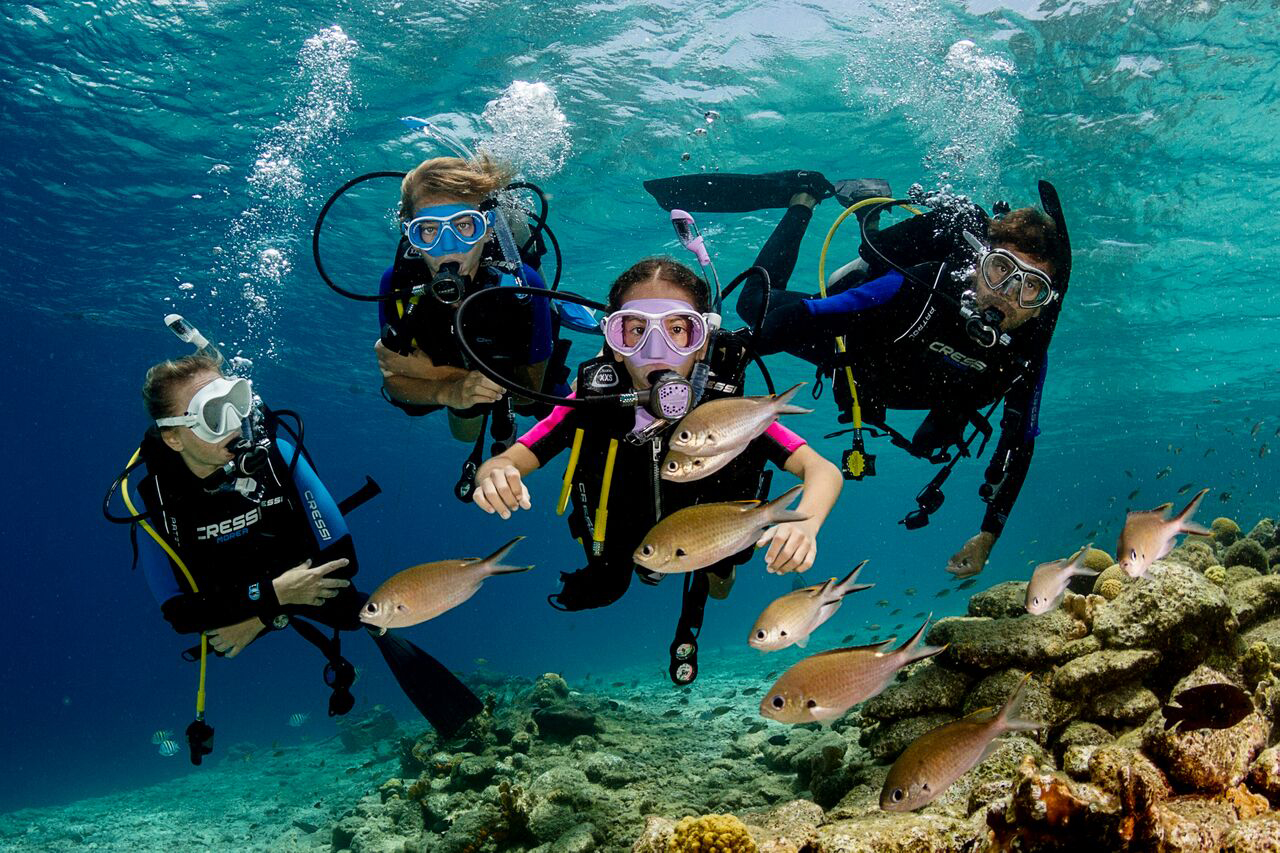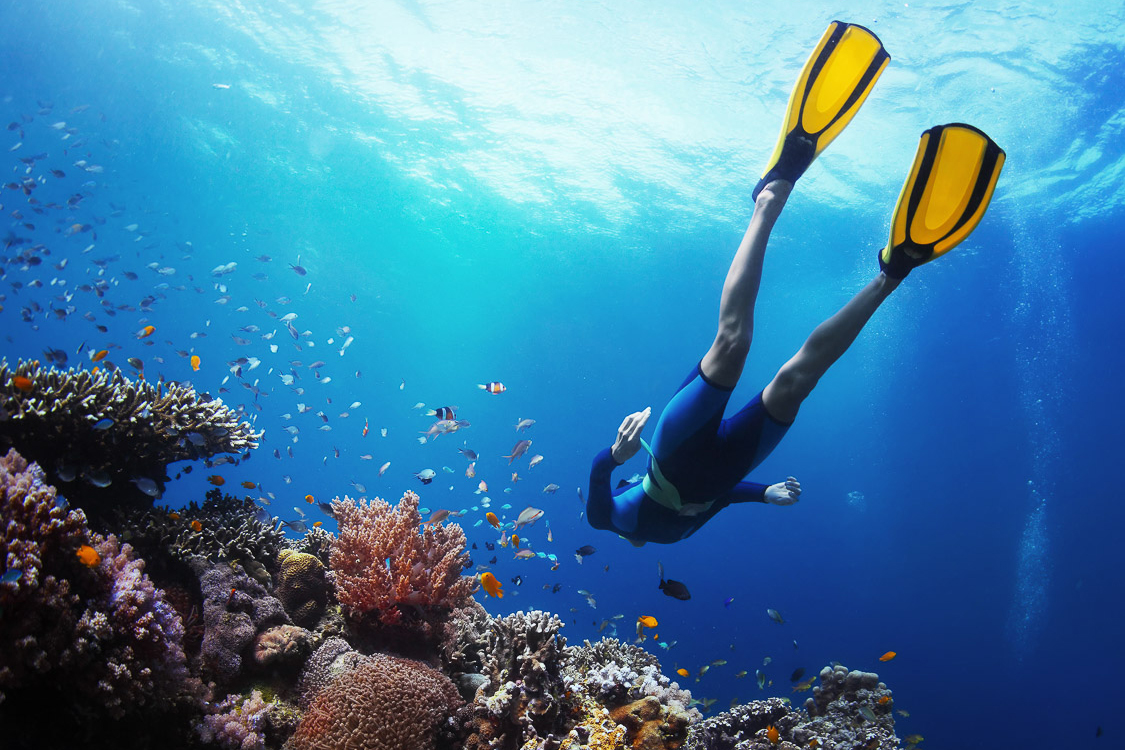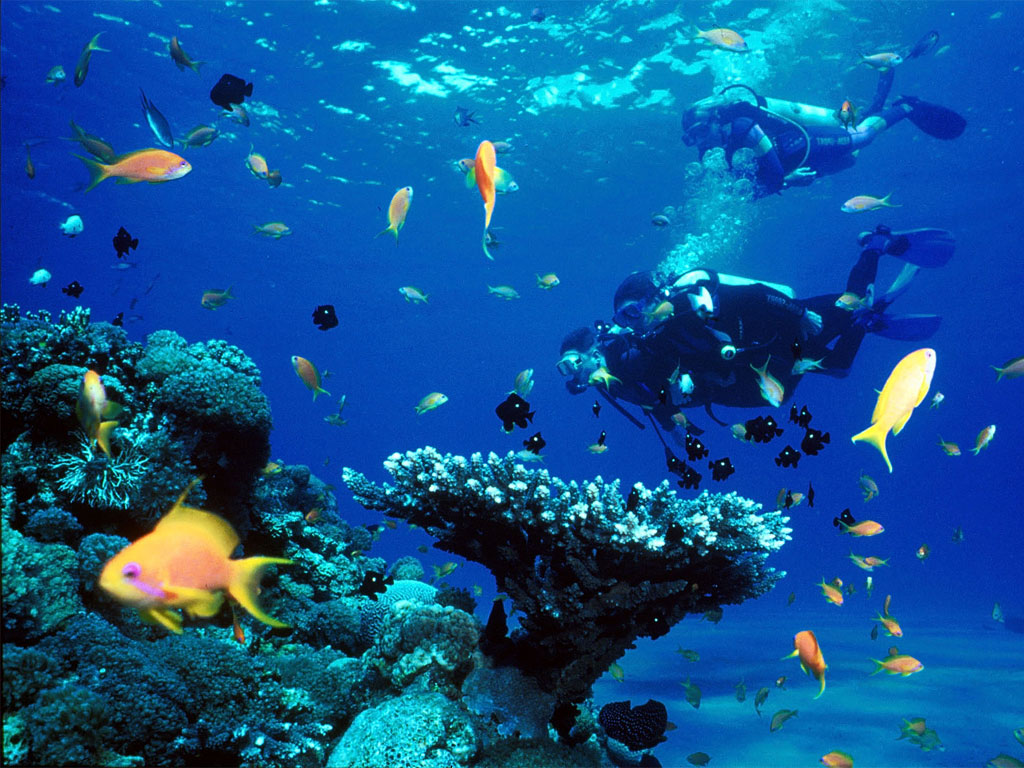
Bonaire is a drive-and-dive island: you collect a pickup with tanks in the back and get in where you like along the sheltered west coast. Around 60 shore sites are marked by yellow stones at the roadside. No boat schedule and no group. A compulsory marine park fee and one checkout dive are the only formalities.
Divers who have only dived from boats find Bonaire disorientating for a day. No dive deck, no roll call, no guide pointing at things: you are handed a truck, a rack of tanks and a map of the coast, and the rest is yours. Most people have taken to it by the third morning. A few never do.
How the drive-and-dive system actually works
Bonaire lies in the southern Caribbean, roughly 80 km off the Venezuelan coast, and the trade winds hit its eastern side, leaving the west coast flat almost every day of the year. One road runs the length of that coast, and the sites are marked from the verge by yellow stones with the name painted on. The marine park counts 88 marked sites along the west coast and Klein Bonaire, and around 60 of those you can walk into from the road, from the salt pans in the south to the edge of the national park in the north.
The mechanics are simple. Your centre issues tanks from a rack by the dock and you swap empties for fulls within its opening hours. The hire car is a pickup with a padded rack in the bed, so four tanks travel upright. Drive to a yellow stone, park, kit up on the tailgate, walk in, dive, walk out. If a site looks wrong when you arrive (surge on the entry, three trucks already there) drive to the next one.
Distances are short: the island is about 39 km end to end, most sites are inside a 20-minute drive of Kralendijk, and only the far ends of the coast (north of Karpata, or south towards Red Slave and the lighthouse) push past half an hour. Nearly every operator sells air as an unlimited package for your whole stay rather than by the dive, which is what makes five dives in a day normal rather than ruinous. One local habit: leave nothing in the truck, because vehicles at dive sites do get broken into.
What you have to do before you can dive on your own
All the water around Bonaire and Klein Bonaire, from the high-water line down to 60 metres, sits inside the Bonaire National Marine Park, and entering it requires a nature fee. It is compulsory and it is not part of your dive package. It is also the same flat charge for everyone in the water — currently 40 US dollars a head, divers and snorkellers alike, since the old split rate was dropped at the start of 2023. It runs for the calendar year rather than for your stay, you can buy it online before you travel or on the island, and rangers do ask to see it.
The rules attached are stricter than most of the Caribbean and they are enforced: no gloves or knee pads without a medical reason, no touching, no collecting, no feeding, no spearfishing, no anchoring. Sunscreen has to be free of oxybenzone and octinoxate, the disposable chemical light sticks and pointer sticks that divers clip on elsewhere are banned outright, and two marine reserves, Queen Maxima and King Willem-Alexander, are closed to diving altogether. Nothing rests on the reef — not your knees, not a camera housing, not a fin tip while you steady yourself.
Coral disease has added one more habit. The park publishes a stoplight map for stony coral tissue loss disease and asks you to work through the day from green sites to yellow to red rather than the other way about, so that nothing travels back to a healthy reef on your kit. Sites do shut when it flares: the whole coast north of BOPEC was closed for most of a year and reopened in January 2024, and diving inside Washington Slagbaai National Park has not come back at all. Check what is open the morning you plan the drive, not the month before you fly.
Then there is the checkout dive, and it is a park requirement rather than a centre’s preference: every diver who has not dived Bonaire within the past calendar year does a mandatory orientation before taking tanks away unaccompanied. In practice that is half an hour on the house reef while a guide checks your weighting and shows you how the tank exchange works. It is not a formality. Most divers arrive over-weighted from years of rental kit, a 3 mm suit shifts that again, and where the top of the drop-off is at 10 metres, two kilos too many shows within minutes.
What the reef looks like once you are in
The profile repeats along the leeward coast, which removes the guesswork. From the shore you cross a shallow terrace of sand, rubble and coral heads, 5 to 10 metres deep and 30 to 100 metres wide. The reef then rolls into a drop-off beginning around 10 to 12 metres and sloping steeply to sand at 30 to 40. The best of it (coral cover, sponges, fish density) sits between about 12 and 20 metres.
Visibility is typically 20 to 30 metres and often more, falling off near town after heavy rain. Water temperature runs from about 26°C in February and March to around 29°C by September and October. A 3 mm full suit covers the year, but if you plan on five dives a day take more neoprene than the numbers suggest: the cold is cumulative.
What lives there is reef life rather than big life — hard coral in better condition than much of the Caribbean, barrel sponges, dense reef fish, turtles on most dives, tarpon hunting in torchlight after dark, and enough frogfish, seahorses and juvenile drums to occupy a macro photographer for a fortnight. The disease that has moved through the wider Caribbean has not spared Bonaire, and on some sites you will swim over scarred heads, though these reefs remain among the healthier in the region.
Which stretch of coast to dive
Since the reef is broadly similar along the coast, choose sites on logistics: how far you drive, what the entry is like, and what the effort buys. That is the shape of most diving holidays in Bonaire we book: ten days or a fortnight of shore diving with a couple of boat mornings in it.
| Stretch of coast | Drive from Kralendijk | Entry | What it gives you | The trade-off |
|---|---|---|---|---|
| North: Oil Slick Leap to Karpata | 10–30 minutes | Limestone ledges, steps, the odd ladder | Best coral cover, steepest drop-offs | Exits need thought; Karpata is a climb in kit |
| Kralendijk and the resort strip | 0–5 minutes | Sand or dock steps, the easiest here | Night dives and unplanned fourth dives | Busiest water; boat traffic |
| South: Salt Pier to Red Slave | 10–35 minutes | Flat sand, the gentlest walks | Hilma Hooker, Salt Pier, double reef | Afternoon wind; pier shut when a ship is in |
| Klein Bonaire | Boat or water taxi, 10–20 minutes | Backward roll or giant stride | Least-trodden reef; nobody can walk in | Costs extra; back on someone else’s timetable |
| Washington Slagbaai, far north | About 40 minutes to the gate | Snorkelling and swimming only | A day off the tanks: empty bays, iguanas, a long dirt loop | No diving inside the park; shut on Mondays, last entry 14:30, high clearance advisable |
The sites people ask about before they book
The Salt Pier is the one everybody wants: a working pier at the salt works in the south, its pilings coated in sponge and coral, with light dropping through it in a way photographers plan the week around. It runs from roughly 6 metres to deeper water at the seaward end, and can only be dived when no tanker is berthed, so never build a day around it.
The Hilma Hooker is the island’s wreck: a freighter of about 72 metres, sunk in 1984, lying on her starboard side between the two southern reefs. The top of the hull is around 18 metres and the sand around 30, so bottom time is short and most people combine her with the reef alongside. She is a shore dive from a roadside pull-in.
Klein Bonaire, the uninhabited islet off Kralendijk, is reachable only by dive boat or water taxi, a crossing of 10 to 20 minutes depending on where you leave from, so its reefs see less traffic than anything on the road. Two of your boat dives are well spent there.
Where you stay, and why it matters more than usual
On a boat-diving holiday the hotel is somewhere to sleep. Here it is your dive centre, your air supply and usually your house reef. Three questions decide it: can you reach tanks early and after a night dive, is a truck with a tank rack included, and is the entry in front easy enough for the day you cannot face driving. Those are what we ask when quoting for the dive resorts we sell on Bonaire.
Harbour Village, on its own marina at the northern edge of Kralendijk, is the quieter, more polished end of the island, with a PADI five-star dive centre on site and easy water in front. The Courtyard by Marriott Bonaire Dive Resort is larger and more conventional, with diving on site, which suits groups where not everybody dives.
Sorobon Luxury Beach Resort is the odd one out, deliberately: it sits on Lac Bay on the windward side, 20 minutes from the dive coast. It is the answer when one of you would rather be on a board. Lac Bay is among the better flat-water windsurfing spots in the Caribbean, and windsurfing and wingfoiling are what happens there: the park does not allow kites in the bay at all, and Bonaire’s kitesurfing is done from Atlantis Beach on the south-west coast instead.
The shallow terrace and absence of surf make it a calm place to learn to dive, and the way round the long flight is a referral: theory and pool work done at home, so the days here are qualifying dives rather than classroom hours. The same shallow water suits families, with one thing worth knowing before you book. A 12 to 14 year old holds a junior qualification and has to dive with a certified adult to a limit of 18 metres, so it is a parent-and-teenager pair rather than two teenagers going off together. From 15 the qualification becomes a full one and they can buddy up between themselves.
When to go, and what it costs you in travel time
Bonaire dives all year. The trade winds blow from the east more or less continuously, which is what keeps the west coast flat; they are strongest from about January to August, which is also the windsurfing season on Lac Bay, and lightest from September into November. The island lies south of the main hurricane track, though a system passing to the north can put swell on the leeward coast for a day or two in autumn. Rain falls mostly between October and January and is brief.
Getting there takes a day: there are no direct flights from the UK. The cleanest routing is a short hop to Amsterdam and then nine to ten hours nonstop to Flamingo airport, about 15 to 17 hours door to door once you count the connection. Going through North America adds a visa waiver, an immigration queue and a bag recheck. The island runs four hours behind the UK in winter and five in summer.
Because the journey is long, most people we send go for ten to fourteen nights, not a week. Plan the last day as a day off: leave 18 to 24 hours between the final dive and the flight home, which takes some discipline when the air is already paid for.
Who this isn’t for
Divers who came for big animals will not find them here. Bonaire has no dependable sharks, no mantas, no schooling pelagics and no season in which that changes. What it has is a healthy reef and a great deal of small life on it. If your best day underwater involves something with a two-metre wingspan, tell us when you call and we will point you at a different trip rather than sell you this one.
Divers who like being looked after will find the standard version of this hard work. Shore diving means lifting tanks in and out of a truck bed, kitting up in the sun at 31°C, walking over broken limestone in boots and timing your own exit through surge, four or five times a day. That is not the only way to dive the island: most of the resorts run guided boat trips, and some of the dive centres we know on Bonaire hold guided groups down to four people, so a fortnight can be built as boat mornings with a crew doing the lifting and shore dives only when you want one. If you would rather that were the whole holiday than half of it, Curaçao is half an hour’s flight west, with a comparable reef and more resorts built around boat diving.
And it is repetitive. The topography barely alters from site to site: terrace, drop-off, slope, sand. Divers who need variety (a wreck one day, a wall the next, a current dive after that) can go flat around day eight. The fix is to change what you look at rather than where: a camera or a fish identification book does more here than driving further up the coast.
Who it does suit is easy to describe. Self-sufficient divers comfortable planning a dive and reading their own gas. Photographers, who get near-unlimited bottom time on a shallow, well-lit reef and can return to the same subject four days running. Couples who both dive. And anyone who has stood on a dive deck at 08:20 wishing they could just get in.
Frequently asked questions
Do you need to hire a car to dive Bonaire?
In practice, yes. The shore sites are spread along about 39 km of coast road and marked by yellow stones, so without a vehicle you are limited to the house reef and to booked boat dives. Almost everyone hires a pickup with a padded tank rack in the bed, which is a local product rather than an ordinary rental car. Arrange it alongside the accommodation so the truck and the air package match.
Is the Bonaire marine park fee compulsory for divers?
Yes. Everyone entering the water inside the Bonaire National Marine Park pays a nature fee, and since 2023 it has been a single flat charge for divers, snorkellers and swimmers alike rather than a higher rate for divers. It runs for the calendar year rather than the length of your stay, you can buy it online before you travel or on the island, and it is separate from anything your dive centre charges. Rangers do check at the sites, so carry the proof with you.
Can you dive the Hilma Hooker and the Salt Pier from the shore?
The Hilma Hooker, yes. She lies in the sand between the two reefs on the south coast, roughly 18 metres to the top of the hull and 30 to the sand, entered from a pull-in at the roadside. The Salt Pier is also a shore entry, but it can only be dived when no tanker is berthed and some operators insist you go with a guide, so take it when it is offered.
Is Bonaire a good place to learn to dive or for a first dive holiday?
It is calm and forgiving: a shallow terrace, little current on the leeward coast and easy entries at many sites. The caveat is the flight, and the way round it is a referral course, with the theory and pool sessions done at home so your days here are qualifying dives rather than classroom hours. It works just as well as a first dive holiday when you already hold a qualification and want to build dives quickly without a boat schedule dictating the shape of your day.
Are there sharks and big fish diving in Bonaire?
Not reliably, and it is better to know that before you book. The occasional eagle ray or reef shark passes through, but there is no season and no site where big animals are the reason to go. What you get instead is hard coral in good condition, heavy reef-fish numbers, turtles on most dives, tarpon at night and a great many macro subjects.
Planning a shore-diving fortnight on Bonaire?
Tell us how many dives you have logged and when you can travel. We will match the dive centre, the air package and the truck to how you actually want to dive, and say so if another island fits better.
Free, with no obligation and no booking fee. We’re a UK dive tour operator, trading since 2001 —
every resort and liveaboard we sell has been dived by one of our own team. Mon–Fri, 09:00–18:00 UK ·
ATOL protected (T7314) and Travel Trust Association members.