Zanzibar is the easy choice, Pemba is the diver’s choice and Mafia is the quiet one with the whale sharks. Mnemba Atoll off Zanzibar is gentle, shallow reef diving with the best flight connections. Pemba’s channel walls run current and reward experience. Mafia has a marine park, very large fish, and surface whale sharks from roughly October to March.
Tanzania is three separate dive trips sharing one country’s name, and they differ more than the brochures let on. One is easy to reach and forgiving to dive. One asks for experience and gives you walls. One is tide-bound, quiet and has the whale sharks.
Which island should you pick?
The three sit along roughly 300 km of coast. Pemba is the northernmost, about 50 km offshore across a channel that drops into deep water very close in. Zanzibar, properly Unguja, sits about 35 km off the nearest mainland coast, though nearer 75 from Dar es Salaam itself, which is the two hours the fast ferry takes. It holds the international airport most people arrive through. Mafia is the southernmost, about 25 km off the mouth of the Rufiji, and that river explains most of what makes its diving different.
Every trip starts at Zanzibar or Dar es Salaam, so the question is how much extra travel you will accept after an overnight flight. That is where our conversations about diving holidays in Tanzania begin, before anyone talks about fish.
| Island | Getting there | Conditions | Marine life | Who it suits | The trade-off |
|---|---|---|---|---|---|
| Zanzibar (Unguja) | International airport; then 10–45 minutes by boat to Mnemba from a north-east base, or an hour or more by road first from the south-east | Sloping reef and shallow wall, 5–30 m, mild tidal drift, visibility usually 15–30 m | Dense reef fish, green turtles most dives, dolphins around the atoll | Mixed-ability groups, newer divers, trips with non-divers along | One busy dive area shared with every centre on the island, unless you go out to Leven Bank or down to the Stone Town wrecks |
| Pemba | Light aircraft from Zanzibar (30 minutes) or Dar es Salaam (about an hour), then a transfer | Walls from 4–8 m past recreational limits, genuine current, visibility 20–40 m | Gorgonians, big sponges, napoleon wrasse, tuna, whitetip reef sharks, the occasional manta | Experienced divers comfortable being carried along a wall | Few lodges, few boats, days lost to wind, no second dive area to fall back on |
| Mafia | Light aircraft from Dar es Salaam (30 minutes) or Zanzibar (about 45, often via Dar) | Sheltered bay and tidal passes, 5–30 m, dive times set by the tide | Very large groupers, heavy biomass inside the marine park, whale sharks October–March by snorkel | Divers who want a protected reef and almost no other boats | Schedule follows the moon, little ashore, most lodges shut in April and May |
Zanzibar: Mnemba, and the easiest week to organise
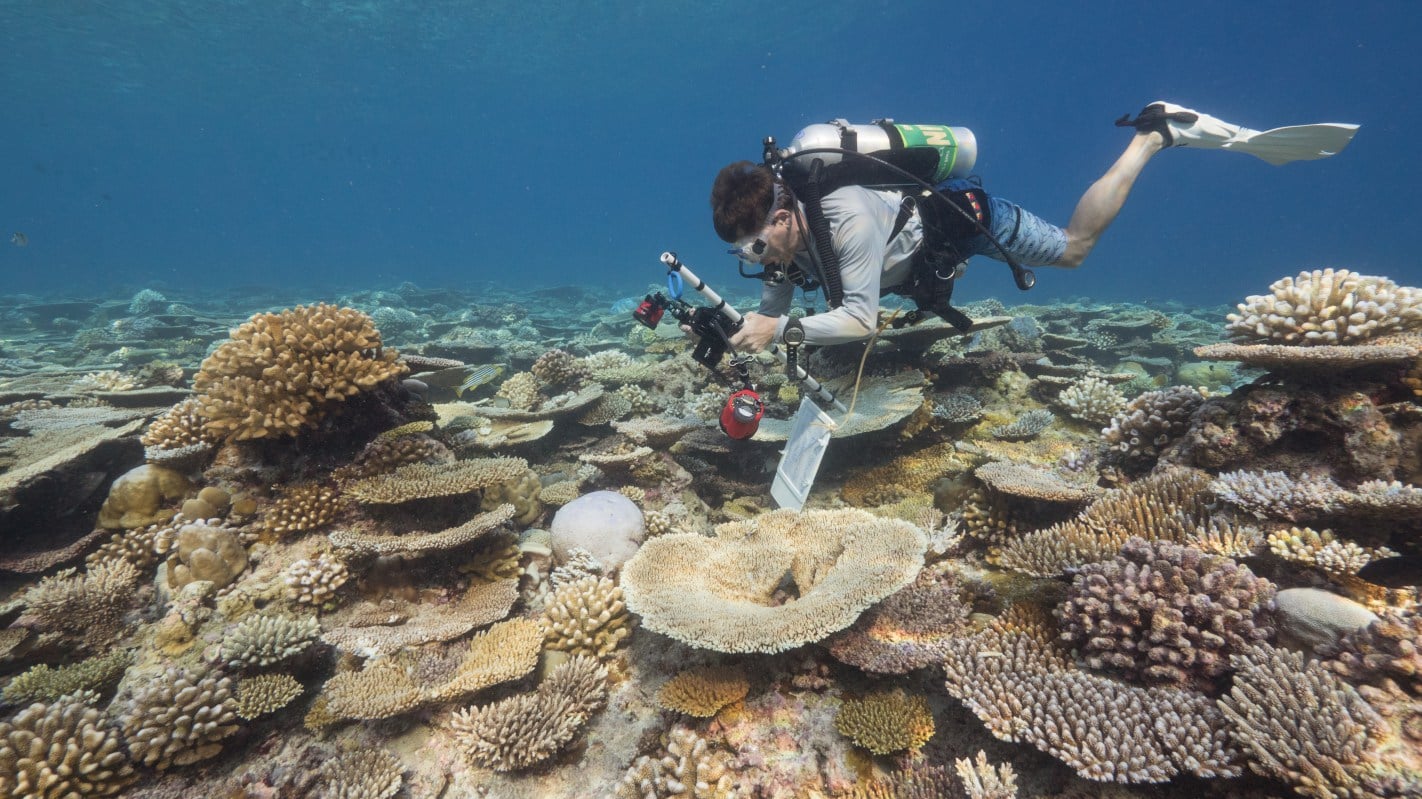
Most of Zanzibar’s diving happens at Mnemba Atoll, a small oval reef off the north-east corner of the island, inside a conservation area that charges a per-person daily fee on top of your diving. Sites such as Kichwani, Wattabomi and Coral Gardens run between about 5 and 30 m on coral slope, with the working part of most dives between 12 and 20. There is tidal movement, but the kind you drift with rather than fight.
Mnemba is not the whole island, whatever the day-trip market implies. Leven Bank, off the northern tip, is a current-swept mound from about 14 m down and the closest thing Zanzibar has to a Pemba dive, which matters if one diver in the group has the logbook for it and the rest do not. The Stone Town wrecks on the west coast are a separate area again, with the Great Northern sitting at about 12 m and diveable by almost anyone. Neither is a reason to book Zanzibar on its own, but both are the reason we push back when someone writes the island off as one atoll.
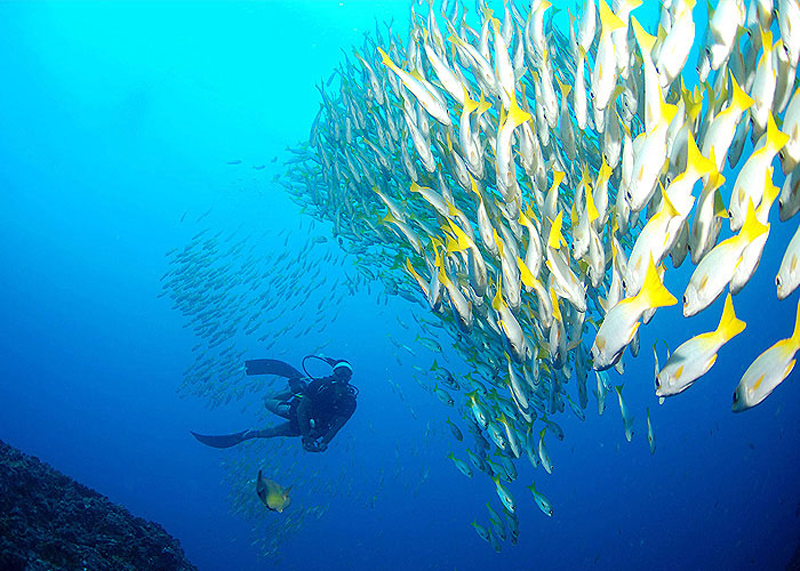
The draw is fish rather than big animals: heavy schooling on the reef edge, green turtles on most dives, and bottlenose and spinner dolphins around the atoll often enough that nobody announces them. From roughly July to October humpbacks work their way through the channel, heading north towards the calving grounds in July and August and then back south with calves from September, and you sometimes hear one underwater before anybody spots a blow.
Where you stay decides how much of your day is spent in a boat. From Matemwe the run to Mnemba is 10 to 15 minutes. From Nungwi or Kendwa it is closer to 45 minutes each way, and from the south-east coast around Paje and Jambiani you face an hour or more by road before you reach a boat at all. That is the most common mistake we correct on Zanzibar bookings. It is also the island where a non-diving partner has a genuinely good week.
Pemba: the channel walls, and who they are actually for
Pemba is separated from the mainland by the Pemba Channel, where deep water runs unusually close inshore. The west coast is a sequence of gaps and drop-offs — Njao Gap, Fundu Gap, Uvinje Gap, Manta Point, Swiss Reef — with the reef top shallow, 4 to 8 m across most of the gaps, and the wall falling past anything you should dive on a single tank. Visibility of 20 to 40 m is normal in the calmer months, and the walls carry gorgonians, barrel sponges and the sort of fish that only sit in current.
The current is why the island stays quiet. Tidal exchange through the gaps can run hard, and a dive there can mean a negative entry, a fast descent and a drift whose pace you do not set. Add a handful of lodges, a handful of boats and no sheltered alternative when the wind turns, and “we are not diving today” becomes a real answer. Pemba Island rewards divers with fifty or so dives behind them, recent time in moving water and no need to be entertained.
Mafia: Chole Bay, the marine park and the whale shark months
Mafia Island Marine Park was Tanzania’s first, declared in 1995, and covers most of the island’s southern and eastern waters, including Chole Bay. A daily park fee applies per person, normally paid locally rather than included in a holiday price, and increasingly by card at the park office rather than in cash, so ask us for the current rate before you budget. The bay itself is a broad, sheltered lagoon reached through a few passes.
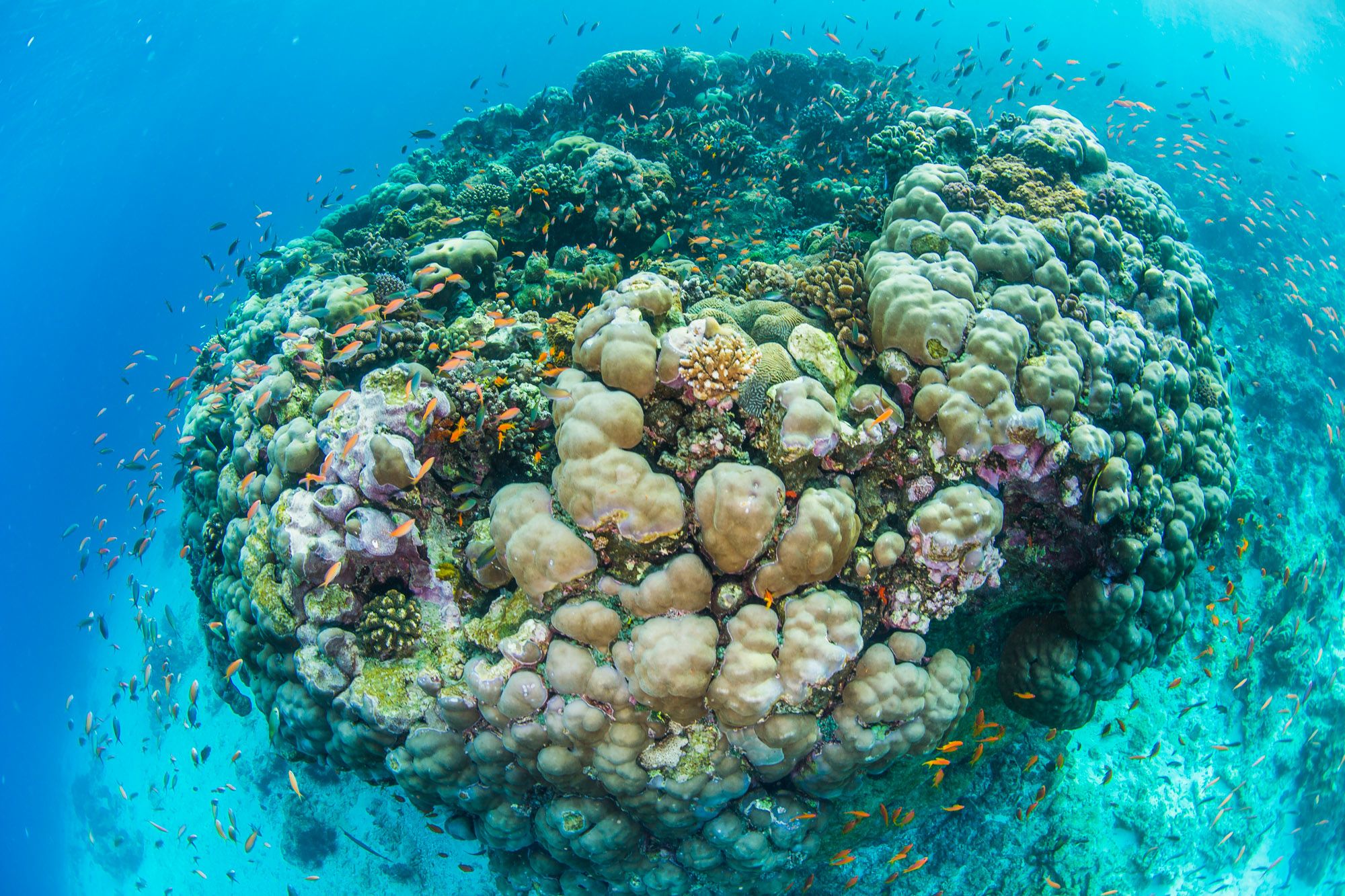
Kinasi Pass on a running tide is the site people remember: 5 to 25 m, moving water, fish stacked up in the flow. Dindini Wall and the outer sites sit on the exposed side and only work when the sea allows. What Mafia has is biomass — groupers of a size you rarely see on unprotected reef, honeycomb morays, snapper and fusilier in numbers. Visibility inside the bay is more often 10 to 20 m than 30, and worse after rain.
The whale sharks are a separate activity on the other side of the island. The animals are largely resident rather than migratory, so the calendar is about feeding rather than arrival: they come up off the west coast near Kilindoni to work the plankton pushed out by the Rufiji, from roughly October to March, with November to February the consistent stretch and the operators who go out daily putting the strongest weeks between November and January. Encounters are by snorkel under a local code of conduct, not on scuba, and the water is green because the plankton is why the animals are there. Anyone booking Mafia Island to photograph a whale shark over a reef in blue water has misread the trip.
When to go, and what the two monsoons do
Two wind seasons govern the year. The kaskazi, the north-east monsoon, runs roughly December to March: lightest winds, flattest sea, water at 29°C or a shade more, and the Mafia whale shark season inside it. The kusi, the south-east monsoon, runs roughly June to September: water down to about 25°C, more wind, swell on any east-facing coast. Pemba’s west-coast walls and Chole Bay are sheltered from it, which is why the kusi costs Zanzibar’s exposed sites more days than the other two.
The long rains, from mid-March into May, are the honest gap in the calendar. Pemba and Mafia lodges close for part of April and May, run-off cuts visibility, and no part of this coast dives well in that window. If those are your only free weeks, look further south — how the seasons work in Mozambique is the better starting point for an April or May trip.
Water runs roughly 25°C to 29°C through the year, so a 3 mm suit covers most trips and a 5 mm is worth packing for three or four dives a day in August. Spring tidal ranges of 3 to 4 m are why boat departures move by an hour or two across a week, and why the east-coast beaches empty out at low water.
What moving between the islands costs you
More than people expect. Zanzibar to Pemba is about 30 minutes by light aircraft. Zanzibar to Mafia is around 45 and often routes through Dar es Salaam anyway. Pemba to Mafia has no direct link, so that hop swallows a full day. A ferry runs between Zanzibar and Pemba, but it is slow and unreliable enough that we rarely put divers on it.
The constraint that catches people out is baggage. Light aircraft on these routes typically allow around 15 kg in a soft bag, excess charged by the kilo and subject to space on the day. If you carry your own regulators, computer, camera housing and a 5 mm suit, plan around that limit rather than the fare.
Getting there at all is a full day. There is no year-round scheduled direct flight from the UK, so you connect through the Gulf, Istanbul, Addis Ababa or Nairobi: roughly 11 to 13 hours in the air plus the layover. That is why we rarely split a seven-night trip across two islands. At 10 to 14 nights, a two-island itinerary starts to work.
Adding a safari without wasting the diving
The safari pairing is what separates Tanzania from a straight reef holiday, and it is where itineraries get built in the wrong order. Do the safari first, then dive. The Ngorongoro crater rim sits at roughly 2,300 m and the Serengeti at around 1,500 m, and going to altitude soon after a week of diving is a decompression risk with nothing to gain. Leave at least 24 hours between your last dive and any flight or drive up-country, longer if you have dived hard.
Nyerere National Park, carved out of the northern Selous in 2019 and still bordered by the reserve to the south, is the closest option to the coast: under an hour by light aircraft from Zanzibar or Dar, low-lying, and strong for wildlife along the Rufiji. The northern circuit costs more time and more internal flying. A seven-night safari and Zanzibar combination is the version we book most, because it puts the game drives first and the diving last, where it belongs.
Who this isn’t for
If you have fewer than about 50 dives logged, or have not been in the water for a couple of years, Pemba is the wrong island and enthusiasm does not change that. The walls are deep, the gaps run current, and there is no shallow alternative for the day you would rather take it gently. Zanzibar is the answer to that rather than the consolation prize: Mnemba on a gentle tide, centres that will run small groups, and Leven Bank still sitting there for the day you want more out of the week. If what you want is a beach base with no safari attached at all, Seychelles is the swap we would make, but book it for the diving rather than to dodge small aircraft, because the inter-island flights there run to much the same 15 kg allowance.
If you are travelling for one animal, this is the wrong coast. Tanzania is reef, wall and fish diving. The Mafia whale sharks are seasonal and by snorkel, the Pemba mantas are occasional, and nobody here sells a shark dive with a number attached. Mozambique does big-animal diving properly, with manta cleaning stations you dive on scuba on the deeper sites past 20 m and whale sharks that turn up across the year rather than in a three-month window, although there too the whale sharks are a surface snorkel rather than a dive.
And if your only free weeks are in April or May, take Tanzania off this year rather than off the list. Lodges close, the rain arrives, and we would rather move you to a coast that is working in those weeks and hold Tanzania for a month that suits it than sell you a week of blown-out visibility.
It suits divers who want two genuinely different halves to one holiday, who can take a light aircraft and a tidal schedule in their stride, and who would rather have a protected reef and a quiet boat than the biggest reef in the ocean. Most of the Tanzania trips we quote end up as a safari plus one island, chosen around the month you can travel rather than the other way round.
Frequently asked questions
Which Tanzanian island is best for diving?
It depends on what you can handle. Pemba has the strongest diving, with deep walls, real current and visibility often past 30 metres, but it wants experience and effort to reach. Zanzibar’s Mnemba Atoll is gentler, better connected and the sensible pick for a mixed group, with Leven Bank off the northern tip if someone in the party wants a harder dive. Mafia has the marine park, the biggest fish and the whale shark season, and the quietest week of the three.
When is whale shark season at Mafia Island?
Roughly October to March, with November to February the consistent stretch and the strongest weeks usually between November and January. The population is largely resident, so the season is about when they surface to feed rather than when they arrive. They work the plankton pushed out by the Rufiji delta off the west coast near Kilindoni, so the water there is green rather than clear. Encounters are by snorkel under a local code of conduct, not on scuba, and nothing is guaranteed in any given week.
Is Zanzibar good for a first dive trip?
More than the other two islands, yes. Mnemba Atoll’s sites sit between about 5 and 30 metres on coral slope, with most of the dive spent between 12 and 20 and only mild drift, water sits in the mid to high twenties all year, and there are enough centres that you can find one running small groups. Stay at Matemwe for the shortest boat ride. Non-divers have Stone Town, the spice farms and a proper beach week.
How do you get from Zanzibar to Pemba or Mafia?
By light aircraft. Zanzibar to Pemba takes about 30 minutes; Zanzibar to Mafia about 45, and it often routes through Dar es Salaam. There is no direct link between Pemba and Mafia, so that move costs a full travel day. Baggage is usually capped near 15 kg in a soft bag, with excess charged by the kilo and subject to space, which matters if you carry your own kit.
Can you combine a Tanzania safari with diving?
Yes, and it is the main reason people choose Tanzania over a pure reef destination. Do the safari first. The Ngorongoro crater rim is around 2,300 metres and the Serengeti about 1,500, so heading up there straight after a week of diving adds decompression risk for no reason. Leave at least 24 hours between your last dive and any flight or drive to altitude.
Not sure which Tanzanian island fits your group?
Tell us when you can travel, how many dives you have logged and whether a safari is part of the plan. We will say which island fits, and in which order to do it.
Free, with no obligation and no booking fee. We’re a UK dive tour operator, trading since 2001 —
every resort and liveaboard we sell has been dived by one of our own team. Mon–Fri, 09:00–18:00 UK ·
ATOL protected (T7314) and Travel Trust Association members.