Musandam is Oman’s fjord coast at the mouth of the Gulf, and it is a current-diving destination rather than a clear-water one. Expect limestone walls, tidal drift and visibility that swings between roughly 5 and 30 metres. Water runs about 22–24°C in winter and 31–32°C in high summer. Almost everyone arrives from Dubai rather than Muscat.
Musandam surprises people twice. It is easier to reach from Dubai than it is from the rest of its own country, and it dives nothing like anywhere else in Oman.
Where this actually is
Musandam is an Omani exclave: roughly 1,800 km² of bare limestone mountain at the northern tip of the Arabian peninsula, cut off from the rest of Oman by UAE territory. It points into the Strait of Hormuz, and much of the tidal exchange between the Gulf and the Gulf of Oman squeezes past its headlands twice a day. That one fact explains most of the diving.
The governorate held just over 49,000 people at the 2020 census, so the infrastructure is thin. Khasab, on the north coast, is the main town and the base most divers use; Dibba Al-Baya, on the east coast, is the other jumping-off point, worked mainly by boats running up from the UAE side. There is no through road between them — the mountain track is closed to visitors, so moving between them means leaving Oman, driving through the UAE and re-entering. Pick one base.
That is why our Musandam trips are quoted from Dubai, and why we treat this as a separate holiday from the Muscat coast and the Daymaniyats rather than a bolt-on.
Are they really fjords
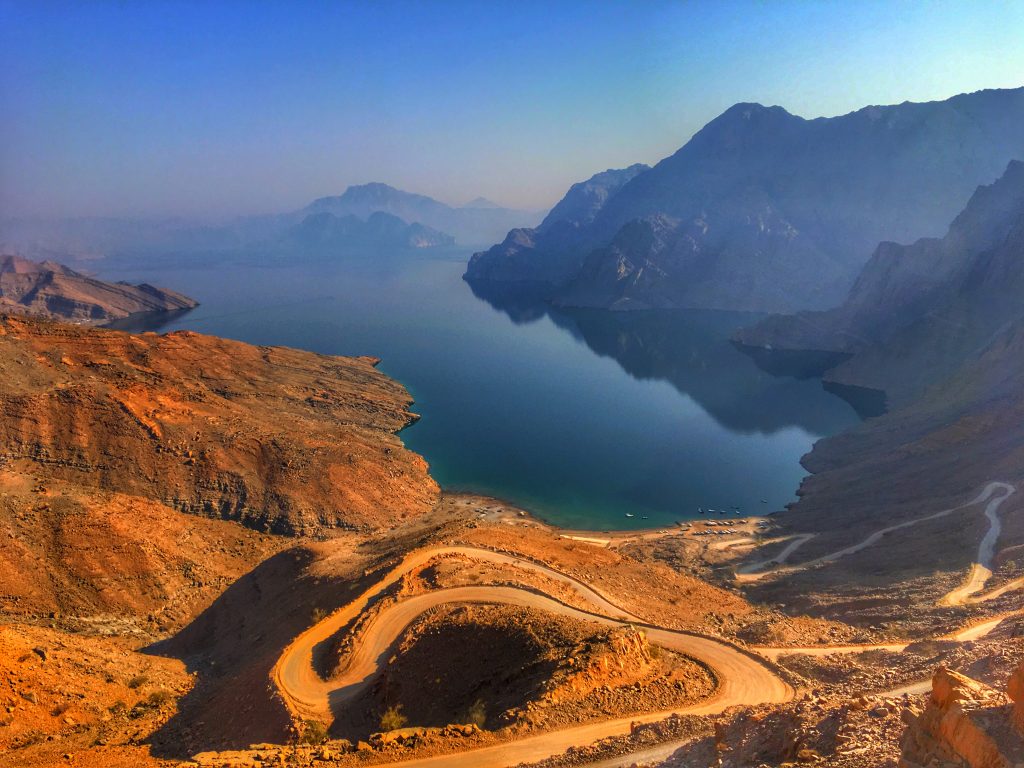
Not in the strict sense, and the difference matters underwater. Every operator sells this coast as the Norway of Arabia, and from the deck of a dhow you can see the argument. But nothing has glaciated Arabia since the Permian, so these inlets (khors, locally) are drowned river valleys, not glacial troughs. The Arabian plate is being dragged beneath Eurasia and this corner of it is slowly sinking, letting the sea flood valleys cut when the land stood higher. Khor Ash Sham, the largest, runs about 16 km inland below cliffs of up to 800 m.
The visual comparison with Norway holds up; the underwater one does not. A glacial fjord has a shallow sill at its mouth and deep, still water behind it. These khors are open-ended tidal channels, so instead of stagnation you get flushing — water moving in and out with force, carrying nutrients, sediment and fish. Inside them the bottom is soft and silty, better for a slow macro dive than a wall — most boats pause in Khor Ash Sham at Telegraph Island, site of a British cable station abandoned in 1868.
What you actually dive
Operators list somewhere between twenty and thirty named sites, and almost all of them are rock: limestone walls, headlands, submerged ridges and free-standing pinnacles. There is coral, but it does not work like a Red Sea reef — hard coral in patches on the shallower shelves, soft corals and gorgonians deeper on the walls, and no commercial fishing pressure, which is a fair part of why the fish life holds up the way it does.
Lima Rock is the one everyone comes for — a bare limestone hump off the east coast with walls on the north and south sides that keep going well past sport-diving depth. Most dives sit in the 15 to 30 m band, and the south wall is the sheltered choice in wind. Octopus Rock, a pinnacle running roughly 5 to 20 m, holds fish out of all proportion to its size when the tide moves. Ras Sarkan runs from about 6 m down past 40, the tide deciding which side you dive. Ras Musandam, the northernmost point, is the serious one and is not offered to everybody. The cave sites sit in 10 to 18 m and forgive a lot.
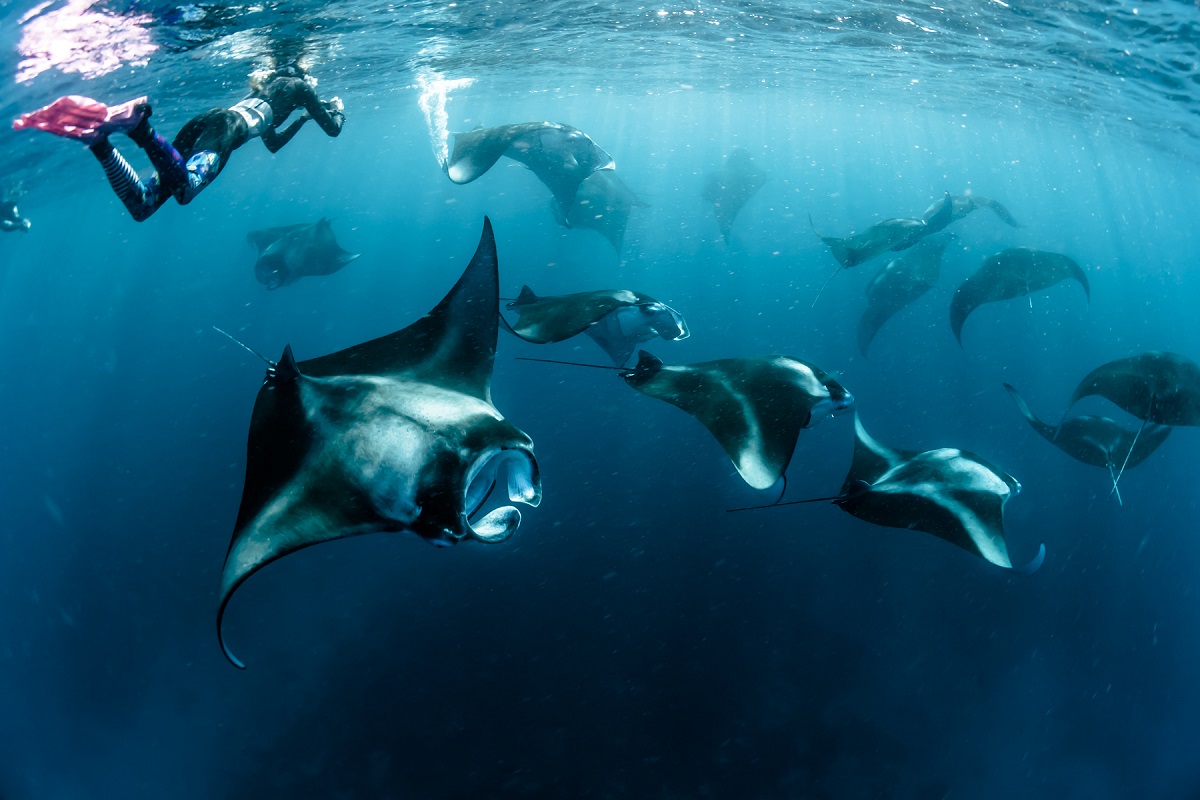
What you see is quantity rather than rarity: fusiliers, snapper and jacks in walls of fish, barracuda in the current, honeycomb morays, stingrays and eagle rays over the sand, turtles, and dolphins on the runs between sites. Whale sharks turn up, mainly September to November, but they are a bonus rather than a reason to book. The centres we work with are on our Musandam dive centre page.
Why the water is green
The same tidal flushing that makes the fish life good is what takes your visibility away. Cool, nutrient-heavy water wells up along the drop-offs and feeds plankton, and the plankton feeds everything else. You cannot have one without the other, and any operator promising 30 m is selling the good day, not the average one.
Expect 10 to 15 m on a normal week, with days at 5 m when a bloom is on and days above 25 m when it is not. One seasonal pattern is worth knowing: the northern Arabian Sea and the Gulf of Oman get large, dependable plankton blooms in the winter monsoon, concentrated between January and March — which is also when the land weather is at its best. The most comfortable month is not the clearest. Thermoclines are normal too, and a layer several degrees colder usually shows as a haze at the boundary.
What the currents do to your dive plan
Musandam currents are tidal, not seasonal, so they change through the day rather than through the year. Guides pick sites off the tide table, dives get moved by an hour or dropped, and the site promised on Tuesday may not be diveable on Thursday.
On the exposed headlands the current can run hard enough that the dive becomes a drift whether you planned one or not, and Lima Rock is known for downcurrents against the wall. Handling that is unremarkable (off the wall, add gas, swim out and up) but it is not a skill to learn on your fourth dive. Negative entries, a good SMB and staying with your guide are standard.
Most operators want an Advanced qualification, or a logbook showing comparable current experience, for the better sites. Two boat dives a day is the normal rhythm, so a week of diving holidays in Musandam comes out at about ten dives once you allow a travel day at each end, or twelve if you build a two-night dhow trip into the middle of the week, where three dives a day is standard.
Day boat, overnight dhow, or a hotel base
There are a handful of sensible ways to buy this, all assuming a UK flight into Dubai.
| How you do it | Getting there | What a day looks like | The catch |
|---|---|---|---|
| Khasab hotel base | 3 to 4 hours by road from Dubai via the Tibat crossing, queues included | Two boat dives most mornings, back by mid-afternoon; north coast and the khors | Khasab is small and quiet; a non-diver will run out of things to do |
| Zighy Bay | About 120 km, two hours from Dubai airport to the Dibba crossing, then a 4×4 run over the mountain | Dive centre on site, small groups, plus a beach for anyone not diving | Comfortably the most expensive way to dive Musandam |
| Day boats from Dibba | Roughly 2 to 2.5 hours by road to the east coast | A long run north towards Lima and back; two dives, a full day | The Dibba crossing has conditions for tourists; arrange it in advance |
| Overnight dhow, 2 to 3 nights | Same start as the Dibba or Khasab boats | Three dives a day, nights anchored in a khor, sleeping on deck | Basic by design: no cabins, shared facilities, no exit if weather turns |
| Muscat and the Daymaniyats instead | Direct UK flights to Muscat, no land border | 45 to 90 minutes by boat to coral gardens in roughly 8 to 25 m | A different holiday: easier, clearer, less dramatic topside |
Where only one of a couple dives, Six Senses Zighy Bay is the one we book most, because the resort holds up on its own terms. For the most dives per pound, Atana Musandam in Khasab has the dive centre on site. To see Musandam alongside the rest of the country, the Oman liveaboards are the tidiest way to do it, though most departures weight the Daymaniyats.
When to go, and what summer really means
The window we would book is October to early May. Within that, October to November and March to early May give the best balance of settled sea, warm water and air you can sit in during a surface interval.
Sea temperatures sit at roughly 22 to 24°C at the low point in January, February and March, climb through the high 20s in May, peak near 31 to 32°C in July and August, and hold around 28°C in November. Treat those as typical rather than promised, since upwelling takes several degrees off at depth. A 5 mm suit and a hood is right from December to March, a 3 mm covers the rest, and in high summer plenty of people dive in a shorty.
Summer is the honest problem. Khasab averages daily highs above 41°C in July and August, with the humidity of a sea-level town to go with it. The water is at its warmest, but a day on an open dhow in that heat is draining. If your leave is fixed then, look at somewhere else in Oman, or accept one dive a day and shade for the rest.
What it costs you in travel time
London to Dubai is about seven hours non-stop, and the UAE runs four hours ahead of the UK in winter and three during British Summer Time, so you land with your body clock intact. From Dubai airport the road north to the Tibat crossing near Ras Al Khaimah takes three to four hours to Khasab, queues included. Zighy Bay is a different road entirely, and people get this wrong: it sits on the east coast just north of Dibba, so you drive about two hours east, clear the border at Dibba rather than Tibat, and go over the ridge and down into the bay. Dibba itself is the nearer entry at two to two and a half hours, but that crossing carries conditions for tourists and needs a confirmed booking behind it.
Coming from Muscat is the awkward route. There is no road through Omani territory at all, so the choices are a flight of about an hour over the 356 km, a long day up the Batinah coast to catch the Musandam fast ferry, which does not sail every day, or six hours or so of driving out through the UAE and back in again with two border posts on the way. If you are combining the two, fly.
On paperwork, Oman dropped the visa requirement altogether for short tourist stays. More than 100 nationalities, the UK included, get 14 days visa-free, granted at the border against a return ticket, confirmed accommodation and travel health insurance — there is nothing to buy or apply for online beforehand, and the paid eVisa only matters if you want longer than a fortnight. The detail has moved before and each land crossing carries conditions of its own, so let us confirm the current position when you book.
Who this isn’t for
If you want clear water, this is the wrong end of Oman and you should not talk yourself into it. Divers who judge a trip on visibility will spend the week frustrated, because the plankton that makes Musandam worth diving is the same plankton that shuts it down to 5 m on a bad week. The Daymaniyat Islands off the Muscat coast give you the clearer water, the coral gardens and the milder currents, on a direct UK flight with no border crossing at all. We wrote up how the two areas compare because it is the most common question we get about Oman, and for anyone who judges a trip on visibility the answer is the Muscat coast, well to the south-east of here.
If you are newly qualified, or have not dived in current before, this is not the place to fix that. It can be done (there are shallow, sheltered sites and centres that will take you) but you will be diving the easy end of a destination whose point is the hard end, watching more experienced people board a different boat. Get thirty or forty dives elsewhere and come back.
And if you are travelling with people who are not diving, look hard at Khasab before committing. It is a small working town, the evenings are quiet, and a week there without a boat to get on is a long one. Zighy Bay solves that and costs accordingly; the alternative is basing the holiday elsewhere and treating Musandam as a few days of it.
Who it does suit: divers with a fair number of dives logged who like moving water, big schools and dramatic rock, who would rather have a headland to themselves than a coral garden with four boats on it, and who can take a cancelled dive without it ruining the week. If that is you, diving in Oman’s far north between October and early May is a good use of a week off.
Frequently asked questions
Do you need to be an advanced diver to dive Musandam?
For the better sites, effectively yes. Most operators ask for an Advanced qualification or a logbook showing comparable experience, because the headland dives are tidal drifts and Lima Rock is known for downcurrents against the wall. Newly qualified divers can be looked after on shallower, sheltered sites in the 10 to 18 metre range, but they will be doing a different trip from everyone else on the boat.
Can you dive Musandam as a day trip from Dubai?
You can, from Dibba on the east coast, at roughly two to two and a half hours each way by road plus a long boat run north. It makes for a very full day and usually gets you two dives. The Dibba border crossing carries conditions for tourists and needs a confirmed booking arranged in advance, so it is not something to turn up and do on spec.
Why is the visibility in Musandam so variable?
Tidal water moving through the Strait of Hormuz brings cool, nutrient-rich water up along the drop-offs, which feeds plankton, which feeds the fish life the area is known for. The trade-off is clarity. Expect 10 to 15 metres on an average week, occasionally 5 metres during a bloom and sometimes above 25. The northern Arabian Sea sees its most reliable blooms between January and March.
Are there whale sharks in Musandam?
They pass through, most often between September and November, and dive centres report them every season. They are not predictable enough to build a holiday around, and no honest operator will promise you one. If a whale shark encounter is the main objective, the Daymaniyat Islands off Muscat give better odds in the same autumn window, and are easier diving besides.
Do you need a visa for Musandam if you are driving in from the UAE?
Not for a short trip, no — but you do stop at immigration. Musandam is Oman, so you clear Omani formalities on the way in: at Tibat near Ras Al Khaimah if you are heading for Khasab, or at Dibba on the east coast if you are heading for Dibba or Zighy Bay. UK passport holders currently get 14 days visa-free, granted at the border against a return ticket, confirmed accommodation and travel health insurance, with nothing to apply for online first. The rules have moved before and each crossing carries its own conditions, so let us confirm the current position at the time you book.
Plan a Musandam dive week that actually works
Tell us your dates and roughly how many dives you have logged, and we will say honestly whether Musandam or the Daymaniyats fits. We handle the flights, the border, the boats and the ATOL protection.
Free, with no obligation and no booking fee. We’re a UK dive tour operator, trading since 2001 —
every resort and liveaboard we sell has been dived by one of our own team. Mon–Fri, 09:00–18:00 UK ·
ATOL protected (T7314) and Travel Trust Association members.