The Bahamas offers the most reliable shark diving in the Atlantic: tiger sharks off Grand Bahama, great hammerheads at Bimini and oceanic whitetips off Cat Island. Beyond the sharks there are steep walls, shallow film wrecks and blue holes. Most shark dives are baited, warm and shallow – and they are not for nervous divers.
What the Bahamas is actually good at
The Bahamas is a shallow bank cut by very deep channels, and that geography does most of the work. Warm, clear water sits over white sand, then falls off a wall into open ocean a short boat ride later. Big animals come close and the sand throws light back at them, which is why so many Atlantic shark photographs come from here.
What it is not is the richest reef in the region. Several destinations beat it on coral cover and fish density, and we would rather say so now than have you surface on day two wondering where the reef went. You come for animals, clarity and space, not a coral garden.
Tiger Beach, and what a baited shark dive involves
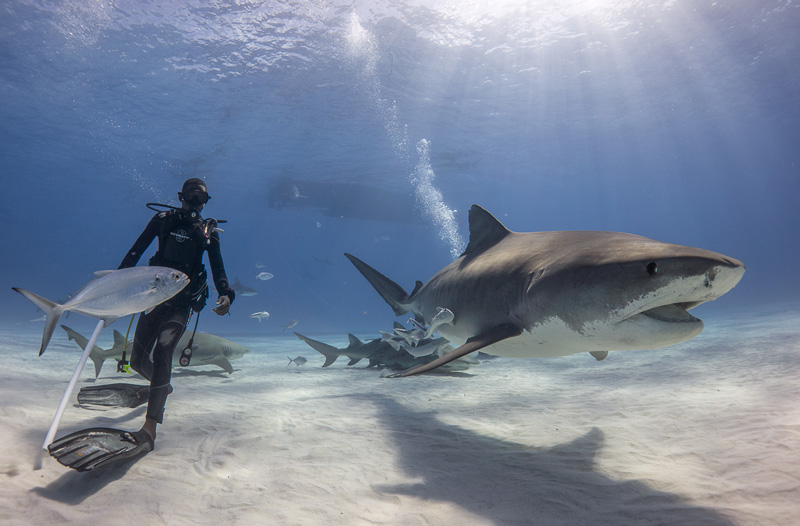
Tiger Beach is not a beach. It is a shallow sand flat off the western end of Grand Bahama, and diving it is about as far from a normal reef dive as scuba gets.
You go in heavily weighted and stay on the sand, kneeling or lying flat, while a crew member, usually in a chainmail suit, works a bait crate. Lemon sharks usually arrive first, often in numbers, with nurse sharks scuffing along the bottom beneath them. Tiger sharks come when they come: some days three for an hour, some days one, late, and worth the wait.
Now the honest part. These are baited dives. The sharks are there because food is there, and they behave accordingly. They will swim straight at you, and you are expected to stay low, keep your hands in and put a flat palm on a snout to turn one that comes too close. That is routine rather than a crisis, but it asks a particular temperament, and there is no cage. Operators want a decent dive count and buoyancy you do not think about, which is why we build most Bahamas diving holidays around a shark itinerary rather than a general reef week.
Where the sharks are, island by island
Shark diving here is not one experience. Each island has its own species, season and logistics, and picking the wrong month is the commonest way people come home disappointed.
| Where | Headline species | Rough season | Conditions | Usual way to dive it |
|---|---|---|---|---|
| Tiger Beach, off Grand Bahama | Tiger, lemon, nurse, reef | Strongest in the cooler months; run much of the year | Shallow sand, long bottom times, exposed crossing | Day boat from the west end, or a liveaboard stop |
| Bimini | Great hammerhead, reef, bull | Roughly December to March | Shallow sand, bright light, cooler water | Short trips from the island, or liveaboard |
| Cat Island | Oceanic whitetip | Roughly April to June | Blue water, no bottom in sight, drifting | Small resort operation or liveaboard |
| New Providence (Nassau) | Caribbean reef shark | Year-round | Reef and wall at recreational depths | Day boats, easiest for non-diving days |
| Exumas and the outer banks | Reef sharks and empty walls | Year-round, calmest in late spring | Remote, weather-dependent | Liveaboard only, realistically |
The walls, the wrecks and the blue holes
The walls are the part most people forget to ask about. Andros lies alongside one of the longest barrier reefs in the world, and its outer edge falls into the Tongue of the Ocean – a true vertical drop with nothing beneath it. New Providence, Cat Island and Long Island have their own drop-offs, sheer and clean, in water clear enough that the wall top reads closer than it is. If walls are the whole point and sharks are incidental, Turks and Caicos does them more consistently within a smaller area.
Wrecks here are shallow and photogenic rather than technical. Theo’s Wreck off Grand Bahama lies on its side on the lip of the drop-off and is the one proper wreck dive most visitors do. The Sapona at Bimini is a concrete hull half out of the water, shallow enough to snorkel. Off Nassau sits a scatter of wrecks and film props at easy depths.
Blue holes are the quiet speciality, and Andros has the greatest concentration, inland and offshore. One caution: Dean’s Blue Hole on Long Island is world famous, but it is a freediving site. On scuba it is a dark funnel and little else, and most divers prefer the smaller ocean holes. Anything with an overhead needs cavern or cave training, not enthusiasm.
When to go
Water is warm all year, sitting in the low-to-mid twenties in deep winter and climbing into the high twenties by late summer. A 5mm suit in winter is not overkill on long shallow shark dives where you barely move.
Winter is the classic tiger and hammerhead season, and also cold front season. North winds shut the crossing to Tiger Beach down for a day or two at a time, so a longer trip buys insurance. Late spring is the underrated compromise: calm seas, warm water, oceanic whitetips off Cat Island and far fewer boats. High summer gives the flattest water and best visibility, but it is hurricane season, roughly June to November and worst from August to October.
Resort week or liveaboard?
A resort base makes sense if you want one island, day boats and time out of the water. Grand Bahama sits closest to Tiger Beach; Nassau is the simplest arrival, has dependable reef shark diving and enough ashore to work as a family dive holiday where not everyone in the group dives.
A boat makes more sense when the sharks are the whole point. Bahamas liveaboard itineraries reach Tiger Beach, Bimini, the Exumas and the outer banks, though not all in one week, with four or five dives a day and no ferries or internal flights. Several sail from Florida rather than Nassau, so budget for a US transit and an ESTA. If you are weighing the two up, tell us the month and your dive count first – that usually settles it, and where we start on every enquiry about diving holidays in the Bahamas.
Who this isn’t for
If baiting sits badly with you, do not book it. It is a reasonable objection and no briefing will talk you out of it mid-week. Unbaited big-animal diving exists – a Costa Rica liveaboard out to Cocos puts you among schooling hammerheads with nobody feeding anything – but it is harder diving in colder water, and the crossing is long.
If you have a modest dive count, or you know you tense up when something large moves quickly, Tiger Beach is not where you find out. And if what you want is unhurried reef diving, macro and coral, the Bahamas will underwhelm you. Bonaire is the better answer: shore diving on your own schedule, healthy reef, nothing to psych yourself up for.
Last, the Bahamas is expensive, and there is no cheap version of it. A week here costs meaningfully more than the same dives in the Red Sea. If value per dive decides it, Marsa Alam gives you more diving for your money on a shorter flight with no US transit. That is not a criticism – it is a different holiday, and knowing which you are after saves a wasted week.
Frequently asked questions
Is shark diving in the Bahamas actually safe?
It is a controlled activity with a good record, but it is not risk-free and it is not for everyone. The dives are baited and there is no cage, so you stay low on the sand, keep your hands in and follow the briefing exactly. A diver who panics and bolts is the real hazard, which is why operators ask about your experience before they confirm a booking.
What is the best month to dive the Bahamas?
It depends entirely on what you want to see. Tiger sharks are strongest through the cooler months, great hammerheads at Bimini run roughly December to March, and oceanic whitetips off Cat Island appear roughly April to June. Late spring gives the best mix of calm seas and warm water. High summer has the flattest conditions but falls inside hurricane season.
How experienced do you need to be for Tiger Beach?
Expect to be asked for an advanced-level certification and a genuine logged dive count rather than a handful of holiday dives. What matters more than the number is whether your buoyancy and weighting are automatic, because you need to hold position on the sand without thinking about it. If you are still working on trim, do an easier week somewhere else first.
Can you dive the Bahamas without a liveaboard?
Yes. Grand Bahama and Nassau both work well as resort bases with day boats, and Nassau in particular suits a group where not everyone dives. A liveaboard mainly buys you access: Tiger Beach, Bimini, the Exumas and the outer banks inside one week, at four or five dives a day, instead of internal flights between islands.
How warm is the water, and what wetsuit should you take?
Warm all year. It sits around 24 degrees Celsius at the coldest point of winter and climbs into the high twenties by late summer. A 3mm is fine in summer, but take a 5mm for a winter shark trip, because those dives are long, shallow and almost motionless and you cool down faster than the water temperature suggests.
Not sure the Bahamas is your trip? Ask us.
Tell us the month you can travel, your dive count and what you most want to see. We will say plainly whether the Bahamas fits, or point you to a destination that suits you better.
Free, with no obligation and no booking fee. We’re a UK dive tour operator, trading since 2001 —
every resort and liveaboard we sell has been dived by one of our own team. Mon–Fri, 09:00–18:00 UK ·
ATOL protected (T7314) and Travel Trust Association members.