Sulawesi is three unrelated dive holidays sold under one name, and choosing the wrong one is the usual mistake. Lembeh Strait is black-sand muck diving for people who want strange small animals. Bunaken is steep coral wall diving with green turtles and clear water. Wakatobi is remote and expensive, reached by charter flight from Bali.
They share an enquiry form and very little else. Two sit either side of one airport in the north; the third is an archipelago off the south-east tip and, as far as your flights go, a separate country. The usual way to have a flat week here is to read that Sulawesi has some of the best diving in Indonesia and book whichever of the three came up first.
What muck diving in Lembeh actually is
Lembeh Strait is a narrow channel between Bitung, a working container port on the North Sulawesi mainland, and the island of Lembeh. The bottom is black volcanic sand and silt. There is coral in the strait, and one or two sites make a feature of it, but coral is not remotely why anyone flies here.
A muck dive goes like this. You drop into 5 to 20 m (few sites need more than 30) onto sand that looks like nothing at all, and then move very slowly. The guide stops and points at what you had taken for a scrap of dead weed, and it is a hairy frogfish. Over the next hour: a coconut octopus carrying half a bottle, a flamboyant cuttlefish, a wonderpus, an Ambon scorpionfish, a blue-ringed octopus if the week is going well, and more nudibranchs than you can be bothered to photograph. Visibility runs anywhere from 5 to 20 m and it barely matters, because your working distance is about a metre.
Whether you love this comes down to one question: do you take pictures? Macro photographers rate Lembeh above almost anywhere, and they are right to. The concentration of odd, cryptic, hard-to-find animals has no real rival, and a good guide hands you subjects faster than you can shoot them. Divers who get in the water for scenery and movement find seventy minutes over black sand a long time. Both reactions are reasonable, and we would rather you worked out which is yours before booking than after.
Most of the operations sit on the Lembeh island side of the channel, with a handful over on the Bitung shore. Lembeh Resort is the one we book most often, and the practical advantage applies to all of them: sites are minutes from the jetty, so a four-dive day is not a four-hour boat day.
Why Bunaken looks like a different ocean
An hour up the road and a boat ride out the other side, and it might as well be a different holiday. Bunaken National Marine Park was declared in 1991 and covers 89,065 hectares, roughly 97 per cent of it water, wrapped around five islands off Manado: Bunaken itself, Manado Tua, Siladen, Mantehage and Nain. The main sites are about 18 km out from Manado Bay, 30 to 40 minutes by boat.
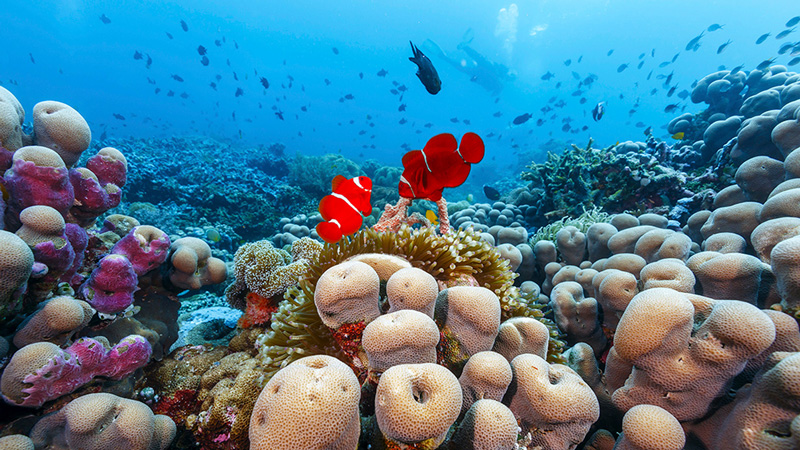
What you dive is wall. A shallow reef flat runs out from the island in 3 to 5 m of water, then stops dead and drops vertically past 40 m into blue — undercut in places, cut with cracks and small caves, and covered in sea fans, sponges and hard coral. You dive it as a drift along the top third and let the depth look after itself. Visibility usually sits between 15 and 30 m and on a settled week is better than that.
The turtles are what people remember. Green turtles are common along the Lekuan walls, often several on one dive, alongside hawksbills, Napoleon wrasse, bumphead parrotfish, whitetip reef sharks under the ledges and fusiliers schooling out in the blue. This is not big-animal diving in the way Komodo is. It is busy, colourful and undemanding, and a reasonably current open water diver is not out of their depth on it.
Staying inside the park rather than on the Manado waterfront takes twenty minutes or more off every crossing, which over six days adds up to the better part of a diving day. Siladen Resort and Spa, on the small island of the same name, is the version we know best. One cost to budget for wherever you sleep: everyone diving inside the boundary pays a marine park entrance fee, issued as a tag and normally collected locally rather than folded into the package price.
What the money buys at Wakatobi
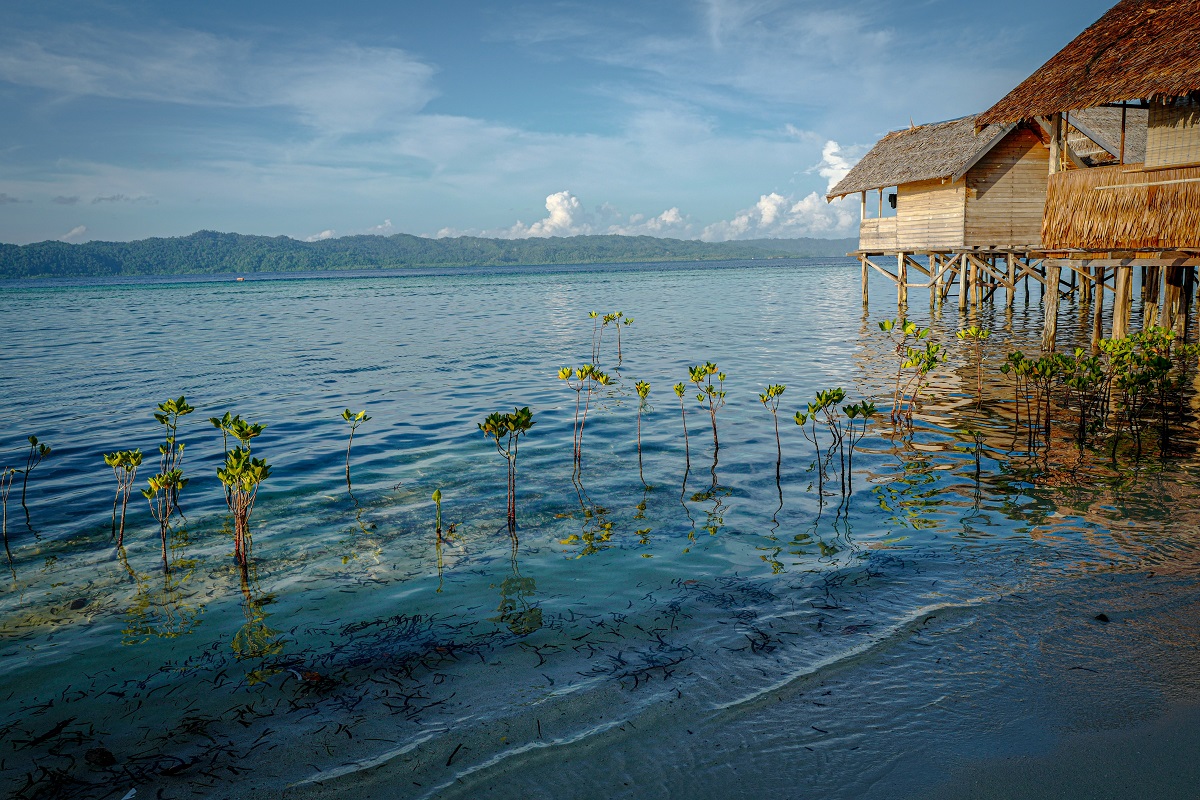
Wakatobi is not on Sulawesi at all, strictly speaking. It is a group of about 140 islands and atolls off the south-east tip, in Southeast Sulawesi province, and the name is a contraction of the four largest: Wangi-Wangi, Kaledupa, Tomia and Binongko. The national park covers about 1.4 million hectares, which makes it the third largest marine park in Indonesia.
Two things justify the premium. The first is water. The area gets something like a quarter of Indonesia’s average rainfall and has no rivers pushing silt offshore, so visibility runs 20 to 50 m and averages around 35, year-round rather than seasonally. The second is the house reef, and that one is not marketing. The coral starts some 40 to 50 m off the beach in front of Wakatobi Dive Resort, and from there the wall drops from under 2 m to beyond 40. A taxi boat will run you up to 500 m north of the jetty from 06:00 to 17:30 and leave you to drift back, and shore staff cover night dives until 22:00.
The effect is that a boat schedule stops setting your dive count. Guests come home from a week with far more dives logged than a standard three-boat-dives-a-day resort would give them, most of them on one reef. The people who love Wakatobi wanted precisely that.
Which of the three suits you
| Where | What you actually see | Conditions | Getting there | Suits |
|---|---|---|---|---|
| Lembeh Strait | Black sand, next to no coral; frogfish, mimic and blue-ringed octopus, rhinopias, nudibranchs, mostly at 5–20 m | Visibility 5–20 m, sheltered, little current, 25–29°C | Manado, then roughly 45–50 km by road and a 10–20 minute crossing | Macro photographers and critter hunters; divers who have had their fill of reefs |
| Bunaken | Vertical coral walls from 5 m past 40; green turtles, Napoleon wrasse, bumpheads, reef sharks | Visibility 15–30 m, some current on the corners, 27–30°C | Manado, then 30–40 minutes by boat | Mixed-ability groups, newer divers, anyone who wants scenery and an easy week |
| Wakatobi | Hard and soft coral in good order, big sea fans, reef fish in quantity, and a wall that starts 40–50 m off the beach | Visibility 20–50 m, mild to medium current, 26–30°C | Bali, overnight, then a charter of under three hours, usually Monday or Friday | Divers chasing dive count and reef quality who will pay for it; wide-angle shooters |
If you already know which row you are in, most of the decision is made. Our diving holidays in Sulawesi cover all three, plus Bangka Island north of Manado and the Togians in the centre, and the first question we ask on the phone is never the budget — it is what you want to be looking at.
When to go
Lembeh dives all year. The wet season runs roughly December to March and the drier, windier stretch is July to September, but neither shuts the strait, because the sites sit inside a sheltered channel. For critters specifically, July to December has the strongest reputation, and the cooler water from July to September pushes the unusual animals shallower even as visibility drops. That trade is worth taking.
Bunaken has a real season. April to October is the settled half. From November to March the wind brings rain and one to two metres of swell; boats still go, but crossings get unpleasant and the exposed sites out at Manado Tua and Nain come off the list. If your leave is fixed in January, we would build the week around Lembeh and treat Bunaken as the excursion.
Wakatobi runs year-round and reckons it has lost four dives in a decade, which broadly matches what guests report back. June to October is the easterly season and the busiest. May and November are the transitional months and often produce the best conditions of the year. December to April brings westerlies and the quietest boats of the year, which is the version to book if you would rather not share a site with anybody.
What the water does, and what suit to bring
Bunaken sits at 27 to 30°C and Wakatobi between 26 and 30, at its coolest around mid-August and warmest in late October. A 3 mm suit covers both without much thought.
Lembeh is the one to pack properly for. It runs 28 to 29°C from October to March, 26 to 27 through the shoulder months, and drops to about 25 to 26 in July and August. Those numbers read as benign and are not, because a muck dive involves almost no swimming: you hang over sand at 12 m for seventy minutes with your hands still, four times a day, for six days. Regulars bring a 5 mm and a hood and are grateful for both by the third day.
What it costs you in travel time
Nothing here is quick, and there is no direct flight from the UK to either gateway. For the north you are aiming at Manado (MDC). The tidiest routing is via Singapore, about thirteen hours from London, then a non-stop of roughly three and a half hours, currently six times a week. There is no non-stop from Kuala Lumpur; the other way in is to route through Jakarta and pick up a domestic flight from there. Plan on leaving home one day and reaching your room the next afternoon.
On the ground the north is straightforward. Bunaken is 30 to 40 minutes by boat from Manado. Lembeh is about 45 to 50 km east by road, an hour to ninety minutes depending on how Bitung is moving, then a crossing of 10 to 20 minutes. Moving between the two is a half day, not a flight.
Wakatobi asks for more. You fly to Bali first, itself a one-stop from the UK, overnight there, and take the resort charter the following morning — under three hours to its own 1,500 m airstrip on Tomia. That charter generally runs Mondays and Fridays, which is the part people miss: your trip length is set by the timetable rather than by your annual leave, and the Bali night before the outbound charter is not optional. Whether you need one on the way home depends entirely on how your flight out of Bali is timed.
Can you do two of them in one trip
Two of them, comfortably. Lembeh and Bunaken share Manado, so a fortnight split between them is the most sensible long trip in North Sulawesi, and the contrast is the point: a week nose-down on sand, then a week flying along walls. Most of the dive centres we work with in Sulawesi arrange the transfer directly, and it costs one afternoon.
Wakatobi does not combine with either. Reaching it from Manado means flying back through Makassar or Bali and waiting for a charter day, which costs the better part of two days in each direction. Treat it as its own holiday and it makes sense; bolt it on and it will not.
Who this isn’t for
If this is your first Indonesian dive trip and what you have in your head is the Indonesia of the photographs (absurd coral, walls of fish, mantas queuing at a cleaning station) then a week in Lembeh will feel like a wrong turn. Bunaken will not: turtles on most dives, walls that go on for miles and water you can see through make a very good first taste of the country, at a fraction of the cost and faff. If it has to be mantas, though, that trip is Raja Ampat, and we would happily send you there first and keep Lembeh for the second visit, by which point muck diving will have something to offer you.
If you do not take photographs and you dive for the sensation of moving through water, do not let anyone talk you into a full week in Lembeh. It is a specialist taste and there is no shame in not sharing it; three or four days inside a wider Manado trip is the sensible dose. And if you are weighing Wakatobi against Raja Ampat on price alone, read what a Raja Ampat trip actually involves first, because the gap between them is smaller than it looks once flights and charters are counted.
If a non-diver is coming, think hard. Manado is a working city, Bitung is a container port, and the Lembeh shoreline is not a beach holiday by any reading. Wakatobi handles non-divers far better — there is sand, a spa, and snorkelling straight off the jetty over the same wall the divers are on — but you are paying dive resort rates for somebody who is not diving.
Who it does suit, region by region: Lembeh wants divers with enough dives logged that reef scenery on its own no longer fills a week; Bunaken wants very little beyond decent buoyancy and takes newly qualified divers happily; Wakatobi wants anybody who will pay for a wall they can dive four times a day without a long boat ride. If that is you, a fortnight diving in Sulawesi split between the two halves of the north is one of the better uses of a long-haul flight. If the budget stretches and the dates are flexible, Wakatobi on its own is the version with no rough edges.
Frequently asked questions
Is Lembeh Strait worth it if you are not an underwater photographer?
It can be, in a smaller dose. Non-photographers who enjoy being shown things they would never have found alone often have a very good three or four days there. What tends to fail is the full week: seventy-minute dives over black sand at 5 to 20 m, four a day, with almost nothing you would call scenery and 5 to 20 m of visibility. Pair Lembeh with Bunaken rather than committing seven nights to it.
How far apart are Lembeh Strait and Bunaken?
They share Manado as a gateway. Bunaken lies about 18 km out from Manado Bay, 30 to 40 minutes by boat. Lembeh is roughly 45 to 50 km east of Manado by road, an hour to ninety minutes of driving, then a crossing of 10 to 20 minutes to the island resorts. Resort to resort, allow half a day with your kit. No internal flight is involved, which is why a two-centre fortnight works so well here.
When is the best time of year to dive North Sulawesi?
April to October is the settled half for Bunaken, when the walls are calm and crossings are easy. November to March brings wind, rain and one to two metres of swell, and the exposed outer sites drop off the list. Lembeh is sheltered and dives all year, with August to December generally rated the strongest for critters. A trip in September or October gives you both at their best.
How do you get to Wakatobi from the UK?
In two stages. You fly to Bali, which is a one-stop from the UK, and stay the night. The resort then runs its own charter from Bali to a 1,500 m airstrip on Tomia, under three hours, generally on Mondays and Fridays. Plan the return the same way; the Bali night before the outbound charter is unavoidable, and whether you need one coming home depends on your flight time. The charter timetable, not your leave, decides how long your trip is, so check the flight days before booking anything else.
Is Bunaken suitable for newly qualified divers?
For most people, yes. The reef top sits in 3 to 5 m and the walls drop away below that, so depth is a choice rather than a requirement, and visibility of 15 to 30 m makes it easy to stay with a guide. Currents do run on the corners of the islands, and a wall does punish sloppy buoyancy, so a refresher on the first morning is a good idea if you have been out of the water a while.
Not sure which Sulawesi trip is yours?
Tell us how many dives you want, whether you shoot macro, and when you can travel. We will say which of the three fits, book the internal legs and the Wakatobi charter, and flag the weeks we would avoid.
Free, with no obligation and no booking fee. We’re a UK dive tour operator, trading since 2001 —
every resort and liveaboard we sell has been dived by one of our own team. Mon–Fri, 09:00–18:00 UK ·
ATOL protected (T7314) and Travel Trust Association members.