Komodo is current-driven diving in a park that sits between two seas, and the tide sets everything about your week. The northern sites hold 27–29°C; southern sites can drop to around 20°C. Reef mantas gather in the greatest numbers from roughly December to February. Most operators want an Advanced card and 30 to 50 logged dives.
Two questions decide this one. How much current are you comfortable in, and how many dives are in the book?
Why Komodo runs current
The park sits in the Lesser Sunda chain between Sumbawa and Flores, with the Sape Strait on its western side: roughly 1,733 sq km, about 603 sq km of it land. Komodo, Rinca and Padar plus twenty-six smaller islands, protected since 1980, UNESCO-listed since 1991.
The fact that matters underwater is simpler. The Flores Sea lies to the north, cooler Savu Sea and Indian Ocean water to the south, and the whole chain sits on the route Pacific water takes as it drains west. Twice a day the tide moves water between the two, squeezing it through the gaps between the islands. Three to five knots is routinely quoted at the pinch points on a big tide.
Everything follows from that: rock faces covered in filter feeders because the food arrives on a conveyor, fish in quantity, sharks holding station rather than passing through, and dive plans built round a tide table. Of everywhere we book across Indonesia, this is where the day is set by the moon rather than the guest. When a guide says the second dive goes in at 10:40 and not before, that is not fussiness.
The north: Batu Bolong, Castle Rock and Crystal Rock
Batu Bolong is a small rock breaking the surface mid-channel between Komodo and Tatawa, its reef starting at the waterline and its walls dropping away past 70 m on both sides. You dive the top 30 m of it and never see the bottom. The current splits around it, so you work the sheltered side, up and down a face as densely covered as anything we sell anywhere. Nobody anchors: the boat drops you and collects you, and if the tide is wrong the guide moves the dive.
Castle Rock is a submerged seamount, summit at roughly 5 m, most of the dive between 18 and 25 m on the up-current side while grey reef and whitetip sharks, trevally and dogtooth tuna work through the fusiliers. Crystal Rock is close by, shallower on top at around 3 m, and a smaller footprint, so the current bends round it more sharply.
Then The Cauldron, which everybody calls Shotgun: a bowl you drop into with most of the dive inside 25 m, and a narrow channel where the tide compresses and fires you out the far end, three to five knots on peak flow. A very good dive if you are relaxed in moving water, and a long few minutes if you are not.
North park, south park, and the temperature that catches people out
This is the detail British divers most often get wrong. Northern Komodo sits at 27–29°C more or less all year and a 3 mm suit is plenty. The south is fed by cold upwelling from the Indian Ocean side and runs materially colder: commonly 20–25°C, and in the strongest upwelling months, roughly June to September, figures of 18–22°C are widely reported. Manta Alley itself is usually quoted at 22–25°C.
If your itinerary crosses into the south, take a 5 mm and a hood. Packing for Indonesia and then meeting 20°C at Cannibal Rock is how people end up shivering out the back half of every dive.
| Part of the park | Typical water | Strongest months | Getting there from Labuan Bajo | The trade-off |
|---|---|---|---|---|
| North: Castle Rock, Crystal Rock, Batu Bolong, The Cauldron | 27–29°C, 3 mm suit | April to October, clearest May to September | About two hours each way by day boat | The strongest current in the park; no place to build confidence |
| Central: Karang Makassar, Mawan, Tatawa, Siaba Besar | 27–29°C, 3 mm suit | October to April for mantas; diveable year-round | 45 minutes to an hour and a half by speedboat | Gentler and busier; the sites everyone starts on |
| South: Manta Alley, Cannibal Rock, Yellow Wall, Horseshoe Bay | 20–25°C, colder in the upwelling; 5 mm and a hood | Mantas peak December to February; crossings roughest June to September | Liveaboard only, in practice | Cold, more swell, visibility often 10–20 m; the best macro here |
Almost every disappointed account of diving holidays in Komodo comes down to a mismatch between one of those three rows and what the diver actually wanted. Pick the row first, then pick the boat.
When the mantas are there
These are reef mantas, Mobula alfredi, typically 3 to 4 m across the wings. More than a thousand individuals have been photo-identified in the park, so this is a resident population, not a lucky sighting.
Karang Makassar, sold as Manta Point, is a long rubble channel in the central park, dived as an easy drift in about 5 to 15 m along a line of cleaning and feeding stations. Mantas turn up there all year, it runs most dependably from roughly October to April, and it is the one manta site an Open Water diver can do comfortably. Manta Alley, at the southern tip of Komodo island, has sand at about 20 m and a narrow channel between two rocky outcrops where mantas hang in the flow. Numbers peak December to February, and twenty or more on a dive is not unusual.
The complication is seasonal, and it runs the opposite way to what most people assume. The cold, plankton-heavy upwelling that pulls mantas onto the southern sites is strongest from roughly June to September, which is also when the south-east monsoon makes the southern crossings windiest and least comfortable. The biggest gatherings come later, through the wet season, when the bloom peaks and the southern bays sit in the lee of a north-westerly. So the trade is this: December to February for manta numbers, with rain, thick water and visibility nearer 10 to 15 m, or April to October for 20 to 30 m and the northern pinnacles at their best, taking the mantas that turn up.
Reef hooks, and the experience operators actually expect
The reef hook question has two answers here, so do not assume. Several liveaboards working the park circulate national park rules listing reef hooks alongside gloves, scooters and knives as not permitted, on the reasoning that a hook ends up in coral sooner or later. Other centres in Labuan Bajo hand them out as standard, as safety kit on the pinnacles. Ask before you pack one: if the answer is no, what you need instead is trim, a low profile and the discipline to stay in the lee.
On experience, be straight with yourself. The sheltered central sites are fine on an Open Water card with ten to twenty dives. For the high-current pinnacles (Castle Rock, Crystal Rock, Shotgun) operators typically ask for Advanced Open Water and somewhere between 30 and 50 logged dives, and our own guidance sits at the top of that range, nearer 50, before you come. Bring your own delayed SMB and be able to send it up from depth, in current, without thinking. That is what guides watch for on a check dive.
Ask what a centre actually runs, too: group sizes, oxygen and a chase boat vary more here than in most places, which is why we list the dive centres we use in the park.
Liveaboard, or a bed in Labuan Bajo
Liveaboard trips run roughly three to twelve days at three or four dives a day, so a standard week comes out somewhere around twenty to twenty-six dives. It is the only realistic way to reach the south: Manta Alley, Cannibal Rock and Horseshoe Bay are not day trips from town at any speed. If the sites you have been reading about are southern ones, you are buying a boat; the Indonesian liveaboard itineraries are the place to start.
Land-based works differently. Day boats from Labuan Bajo reach the central sites in about 45 minutes to an hour and a half, the northern pinnacles at around two hours each way, which makes a long day with two or three dives in it. In return you get a bed that stays still and the ability to take a day off without stranding anyone. AYANA Komodo Resort sits on Waecicu Beach with a 250-metre private jetty and its own 54-metre phinisi, which shortens the morning considerably. Plataran Komodo Beach Resort is in a quiet cove on the same stretch, and the one we book most when only one half of a couple dives.
Rule of thumb: for the south and the named pinnacles in one trip, take the boat. Travelling with a non-diver, or happier diving four days than eight, stay ashore and do the north and centre properly.
What it costs you in travel time
There are no direct flights from the UK. London to Denpasar runs somewhere between 17 and 19 hours on a one-stop routing, and the Gulf carriers are no slower than Singapore for it. Denpasar to Labuan Bajo is then about an hour and a quarter, several departures a day, and Jakarta runs services of roughly two and a half hours. Direct international flights into Labuan Bajo have come and gone (Singapore and Kuala Lumpur have both been served and then dropped again) so do not build an itinerary round one without checking it is still flying. With connections, budget a full day and a bit each way.
That is why we rarely sell a bare week here. Adding Bali or Ubud on the front costs little extra flying and a good deal less jet lag, which is the thinking behind our combined Bali and Komodo trip.
Park entry has tightened, too. The park authority has brought in a daily visitor cap of 1,000 from April 2026, counted across everyone entering rather than divers alone, and entry tickets are increasingly bought online in advance with passport details rather than paid for on the jetty. Your operator handles it; what it means for you is that names and dates need settling earlier than they used to.
The dragons, and the day you don’t dive
Rinca is the sensible choice. Loh Buaya is 45 to 60 minutes from Labuan Bajo by speedboat, about two hours on a slower boat, and the ranger-led trails run roughly 30 minutes, an hour or two hours. Komodo island’s landing at Loh Liang is further out and only makes sense if your boat is already down there. Park counts put around 1,300 dragons on Rinca and 1,700 on Komodo; males reach about 3 m and roughly 70 to 90 kg, lighter than the photographs suggest and quite big enough at ten paces. You stay behind the ranger, on the trail, two metres back.
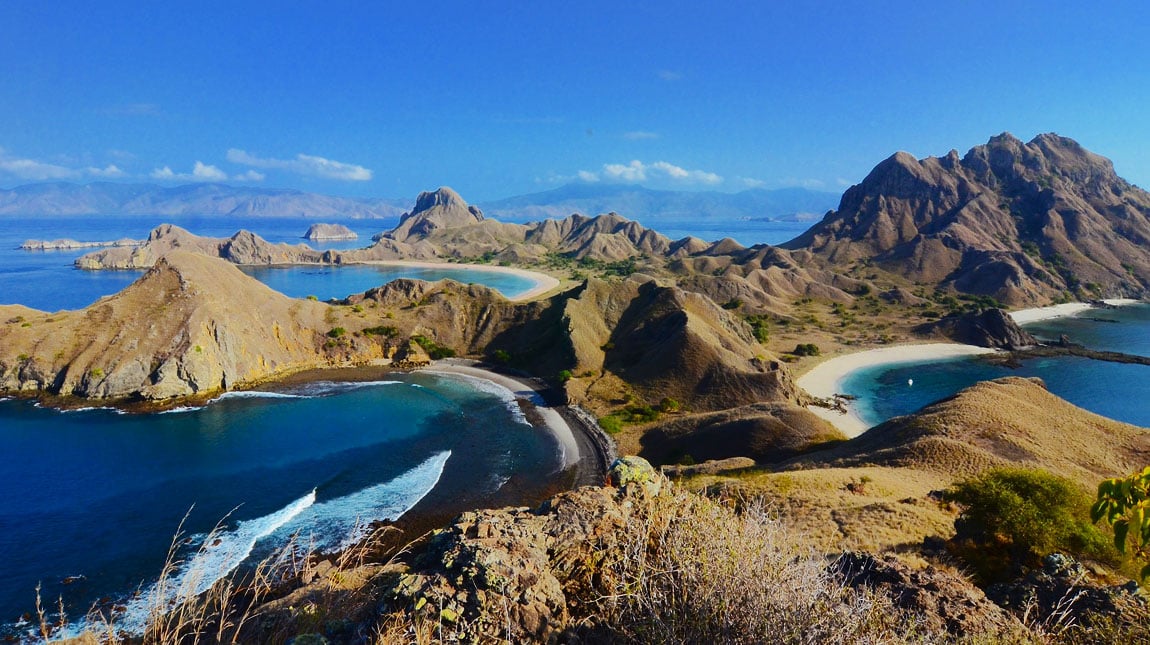
Padar is the other half-day worth taking, a short steep climb to the viewpoint over three bays. On a liveaboard both slot into a surface interval. From Labuan Bajo the dragons cost you a diving day, which is a fair trade once.
Who this isn’t for
If you qualified this year, this is not where to build your dive count. You will be sold a pleasant drift at Karang Makassar and a couple of gentle reefs, and then spend the week on the boat while other people do Castle Rock. That is not the operator being unkind, it is a current risk assessment. Log thirty or forty dives somewhere forgiving first — Bali does that job well, and our notes on the best of Bali’s dive sites cover where.
If what you want is calm, warm, easy water, look elsewhere and do not feel bad about it. Shore entries, a house reef you can potter along at your own pace, 29°C, nobody counting knots: that is the Maldives, or the quieter end of Bali, and we sell both, so say the word and we will put you on the right one. Komodo gives you none of it. The current is the destination.
And if your leave is fixed, understand what you are buying. Sites get moved or dropped when the tide is wrong, the December to February manta window comes with rain and thick water rather than glassy visibility, the June to September crossings to the south are the roughest of the year, and a southern itinerary can lose a day to weather at either end of the calendar. Divers who need a guaranteed number of dives logged by Friday are happier somewhere with a sheltered bay to fall back on.
Who it does suit: divers with thirty or forty dives and up who are relaxed in moving water, who would rather watch a wall of trevally than a quiet reef, and who can take a 20°C dive in their stride if the itinerary heads south. If that is you, this is one of the few destinations that delivers more than the photographs suggest, and a week in Komodo National Park is worth planning around the tides rather than the calendar.
Frequently asked questions
How many logged dives do you need to dive Komodo?
For the sheltered central sites, an Open Water card and ten to twenty dives is usually accepted. For the high-current pinnacles that made the destination’s name (Castle Rock, Crystal Rock and The Cauldron) operators generally want Advanced Open Water and roughly 30 to 50 logged dives, with recent drift experience. Our own guidance is to aim for the upper end of that, around 50 dives, before you book the pinnacles. Guides assess you on a check dive and may hold you back from a site.
Is the water in Komodo cold?
In the north and centre, no: it sits at about 27 to 29°C year-round and a 3 mm suit is comfortable. The south is a different matter. Cold upwelling from the Indian Ocean side brings it down to roughly 20 to 25°C, and between about June and September figures of 18 to 22°C are commonly reported at sites such as Cannibal Rock. Take a 5 mm and a hood for any southern itinerary.
When is manta season in Komodo?
Reef mantas are resident all year, but numbers peak between about December and February, when plankton is thickest and Manta Alley in the south can hold twenty or more on a single dive. Karang Makassar in the central park is dependable from roughly October to April and is the easier of the two. The trade-off is that the peak manta months bring rain and thick plankton, with visibility nearer 10 to 15 metres; the roughest crossings to the south come later, from about June to September.
Do you need a liveaboard to dive Komodo, or can you go from Labuan Bajo?
Both work, for different trips. Day boats from Labuan Bajo reach the central sites in about 45 minutes to an hour and a half, and the northern pinnacles in around two hours each way, which is enough for two or three dives. The southern sites (Manta Alley, Cannibal Rock, Horseshoe Bay) are effectively liveaboard-only. If the south is on your list, book a boat.
Are reef hooks allowed in Komodo National Park?
It depends on who you dive with, so ask before you travel. Several liveaboards circulate park guidance listing reef hooks along with gloves, scooters and knives as not permitted, because hooks damage coral. Other Labuan Bajo centres provide them and regard them as safety kit on the pinnacles. Do not assume either way, and if your operator says no, plan on good trim and staying low in the lee instead.
Plan a Komodo trip around the tides
Tell us how many dives you have logged, when you can travel and whether the southern sites matter to you. We will say liveaboard or land-based, sort the Bali connection and the park permits, and flag the weeks we would avoid.
Free, with no obligation and no booking fee. We’re a UK dive tour operator, trading since 2001 —
every resort and liveaboard we sell has been dived by one of our own team. Mon–Fri, 09:00–18:00 UK ·
ATOL protected (T7314) and Travel Trust Association members.