The Great Blue Hole is a short, dark, deep dive: roughly eight minutes at 40 metres to look at ancient stalactites, with almost no coral and very little marine life. Most divers find Belize’s barrier reef walls and its three outer atolls far better diving. Do the Blue Hole once, for the geology, then dive elsewhere.
What the Blue Hole dive is actually like
The Great Blue Hole sits near the centre of Lighthouse Reef, roughly 300 metres across and well over 100 metres deep. It was a dry limestone cave during the last ice age; sea levels rose, the roof collapsed and the sea filled it. That history is the point of the dive, because what you go down to see is the stalactites – tilted fingers of rock hanging off an undercut wall at around 30 to 40 metres, formed in open air, now underwater.
The dive is simple and fast: over the rim into blue-black water, down the wall to about 40 metres, in under the overhang, look up, then back. No-decompression limits give you somewhere around eight minutes down there. There is no coral, hardly any fish and very little colour. You may see a reef shark patrolling the blue on the way up. You may see nothing at all.
Add narcosis, which at 40 metres in low light is noticeable for most people, and the dive is over almost before it registers. Divers surface either quietly impressed by the scale of the thing, or faintly baffled that this is the famous one.
So is the Blue Hole worth it?
Once, yes, for reasons that have little to do with marine life. It is the strangest piece of underwater geology you can reach on a recreational certification, and hanging off that wall looking into a hundred metres of empty blue is odd. It is packaged sensibly, too: the standard Blue Hole day is three dives, and the two that follow are better.
What it is not is a week’s diving. If you have flown from the UK, changed planes in the States and spent what it costs to reach Belize, the Blue Hole should be one dive out of twenty rather than the reason you came. The divers who come home disappointed are nearly always the ones who booked because of the photograph taken from a plane. Operators want an advanced certification and recent deep experience, and rightly so.
The reef and the atolls, which are the real reason to come
Belize has the largest barrier reef in the northern hemisphere running the length of its coast, and outside it sit three of the Caribbean’s only true atolls: Turneffe, Lighthouse Reef and Glover’s Reef. The atolls are where this country earns its reputation.
Half Moon Caye Wall, a short hop from the Blue Hole, starts as a shallow sand plateau full of garden eels and stops dead at a vertical drop covered in sponges and sea fans. The southern tip of Turneffe catches current and holds schools of jacks and snapper, with eagle rays and turtles regular. Glover’s Reef is the least dived, and the one people talk about afterwards. The week-long Belize liveaboard itineraries we book are built around reaching all three, which no day boat can do.
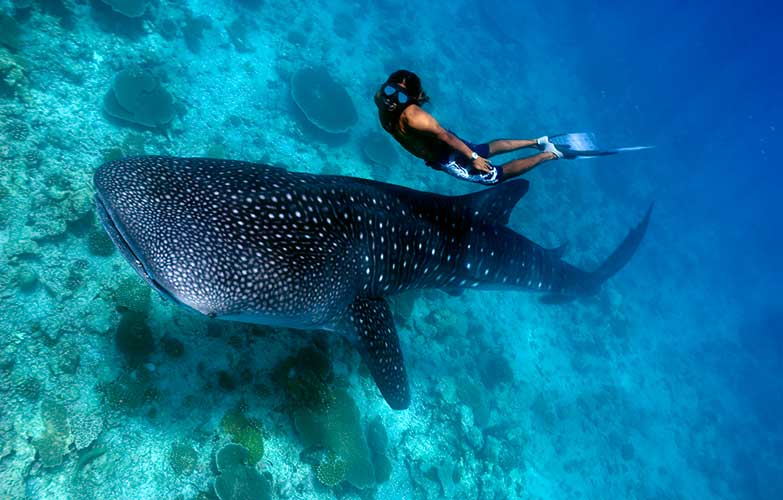
Closer in, the reef off Ambergris Caye gives you Hol Chan Marine Reserve, its nurse sharks and stingrays: shallow, busy with boats, and honestly a better snorkel than a dive. Off the south coast near Placencia, whale sharks gather around the April-to-June full moons when the snapper spawn. It has never been a guarantee and lately less reliable still, so we would rather say so now than after you have booked.
How the main Belize dives compare
| Dive site or area | Typical depth | What you see | Time in the water | Worth the trip? |
|---|---|---|---|---|
| Great Blue Hole, Lighthouse Reef | Around 40 m | Stalactites, bare limestone, the odd reef shark | Roughly 8 minutes at depth | No – once is enough |
| Half Moon Caye Wall | 10–30 m | Garden eels, then a sheer wall of sponges | A full dive | Yes |
| Southern Turneffe Atoll | 15–30 m | Current, schooling jacks and snapper, eagle rays | A full dive, often a drift | Yes |
| Glover’s Reef | 12–30 m | Healthiest coral, fewest other divers | Several dives, boat only | Yes, if the itinerary reaches it |
| Hol Chan and Shark Ray Alley | 3–10 m | Nurse sharks, stingrays, plenty of other boats | Short and shallow | No – better as a snorkel |
When to go
Water runs from about 26°C in winter to around 29°C in late summer, so a 3mm suit covers most people. The drier months, broadly late November to May, bring settled conditions and the clearest water, and that is when most boat schedules run. Summer and autumn are wet, and the Atlantic hurricane season.
The part the brochures skip is the winter cold fronts, known locally as northers. They blow through for a few days at a time and make the crossing to the outer atolls rough or impossible. Day boats cancel, and if you had one week and one chance at the Blue Hole, you lose it.
Liveaboard, or a base on the cayes?
From San Pedro on Ambergris Caye, the Blue Hole is well over two hours each way in an open boat and a long day for three dives. It works, but it puts your one big day at the mercy of the wind and leaves the rest of your diving on the inner reef. A land base makes sense when diving is part of the holiday rather than all of it: Belize handles family dive holidays better than most of Central America, helped by English being the official language.
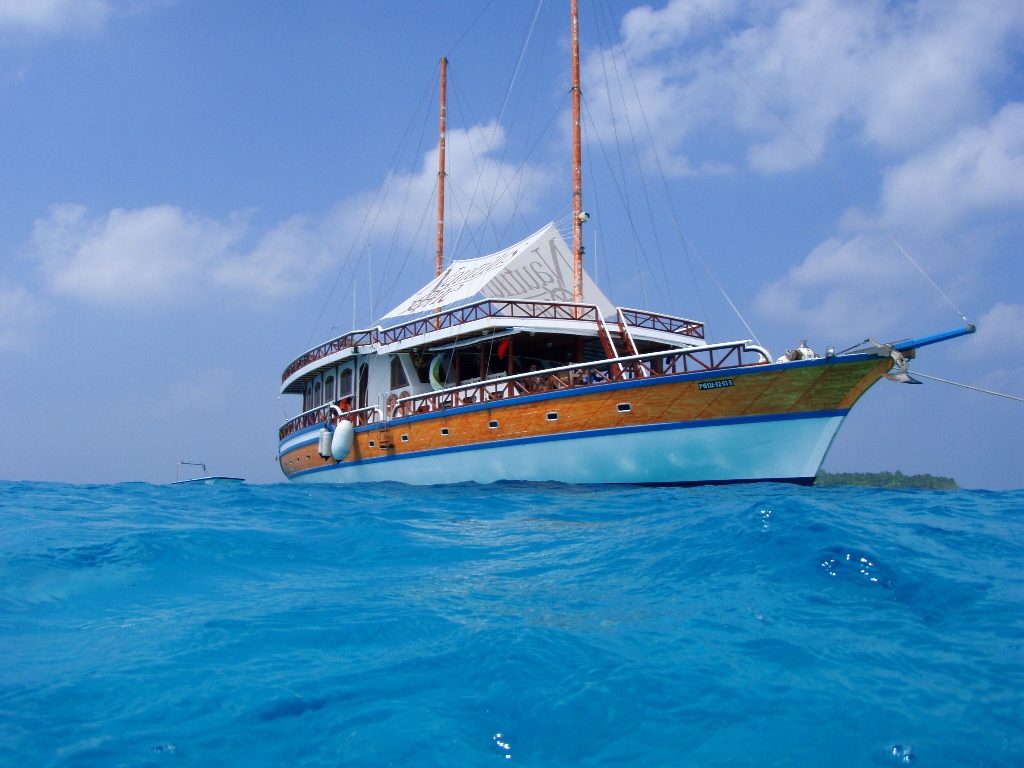
If the diving is the holiday, the boat wins and it is not close. Belize liveaboard itineraries park you on the atolls overnight, turning a two-hour crossing into a five-minute tender ride and giving you three or four dives a day rather than one showpiece outing a week. Getting there takes planning either way: there are no direct UK flights, so you connect through a US hub (which means an ESTA) or via Mexico.
Who this isn’t for
If you want reliable big-animal diving, Belize will frustrate you. The walls are lovely and the coral is in good order, but you will not be surrounded by sharks and the whale sharks are a lottery. Divers who want that should look at the Bahamas, where shark diving is the proposition rather than a bonus.
If you want to dive as much as you like without a boat timetable, this is the wrong holiday. Bonaire lets you load tanks into a truck and dive from the shore at your own pace.
If this is your first dive trip abroad, the outer atolls are a lot of open water and the Blue Hole should not be on the list at all. A learn to dive holiday closer to home makes more sense: Marsa Alam and the Red Sea are one flight from the UK, not a day of connections. For wall diving of a similar character with a simpler journey, Turks and Caicos is the easier trip.
Belize suits divers who want walls, clear water and atolls most people cannot place on a map, and who can take the Blue Hole for what it is: a strange, brief dive that will not be the best of the week.
Frequently asked questions
Is the Great Blue Hole worth diving?
Once, for the geology rather than the marine life. It is a short, dark dive to around 40 metres to look at ancient stalactites, with almost no coral and very few fish. Build the week around the barrier reef and the outer atolls, treat the Blue Hole as a curiosity, and you will come home happy.
What do you actually see in the Blue Hole?
Bare limestone walls and huge stalactites hanging off an undercut ledge at about 30 to 40 metres, formed when the cave was dry during the last ice age. Very little lives down there and fish are scarce. A Caribbean reef shark sometimes cruises past in the blue, but it is not reliable.
Do I need an Advanced certification to dive the Blue Hole?
In practice, yes. The dive reaches about 40 metres, so operators ask for an advanced qualification and recent deep experience, and some want to see logged dives. Narcosis is noticeable at that depth in low light. If you have not dived for a while, do a couple of check dives on the reef first.
Is Belize better from a liveaboard or from a hotel on the cayes?
A liveaboard, if the diving is the point. It puts you on the three outer atolls overnight and gives you three or four dives a day instead of one long outing. From San Pedro the Blue Hole is over two hours each way, and wind can cancel the trip. A land base suits divers travelling with people who do not dive.
When is the best time of year to dive Belize?
Broadly late November to May, the drier months, when conditions are most settled and the water is clearest. Water sits around 26 degrees Celsius in winter and closer to 29 in late summer. Summer and autumn bring rain and the Atlantic hurricane season, and winter cold fronts, called northers, can shut the crossing to the outer atolls for a few days.
Wondering if Belize is right for your next dive trip?
Tell us what you want from the week – wall diving, the outer atolls, a first liveaboard, non-divers along – and we will tell you honestly whether Belize fits or whether somewhere else would suit you better. We have dived these sites ourselves, and we would rather send you to the right place than sell you the wrong one.
Free, with no obligation and no booking fee. We’re a UK dive tour operator, trading since 2001 —
every resort and liveaboard we sell has been dived by one of our own team. Mon–Fri, 09:00–18:00 UK ·
ATOL protected (T7314) and Travel Trust Association members.