The Azores dive from roughly May to October, and the offshore banks only settle enough from June to early October. Water runs about 19°C in June and 22 to 24°C by late August. The draw is mobula rays, blue sharks and volcanic terrain, not coral. It is about four hours from London.
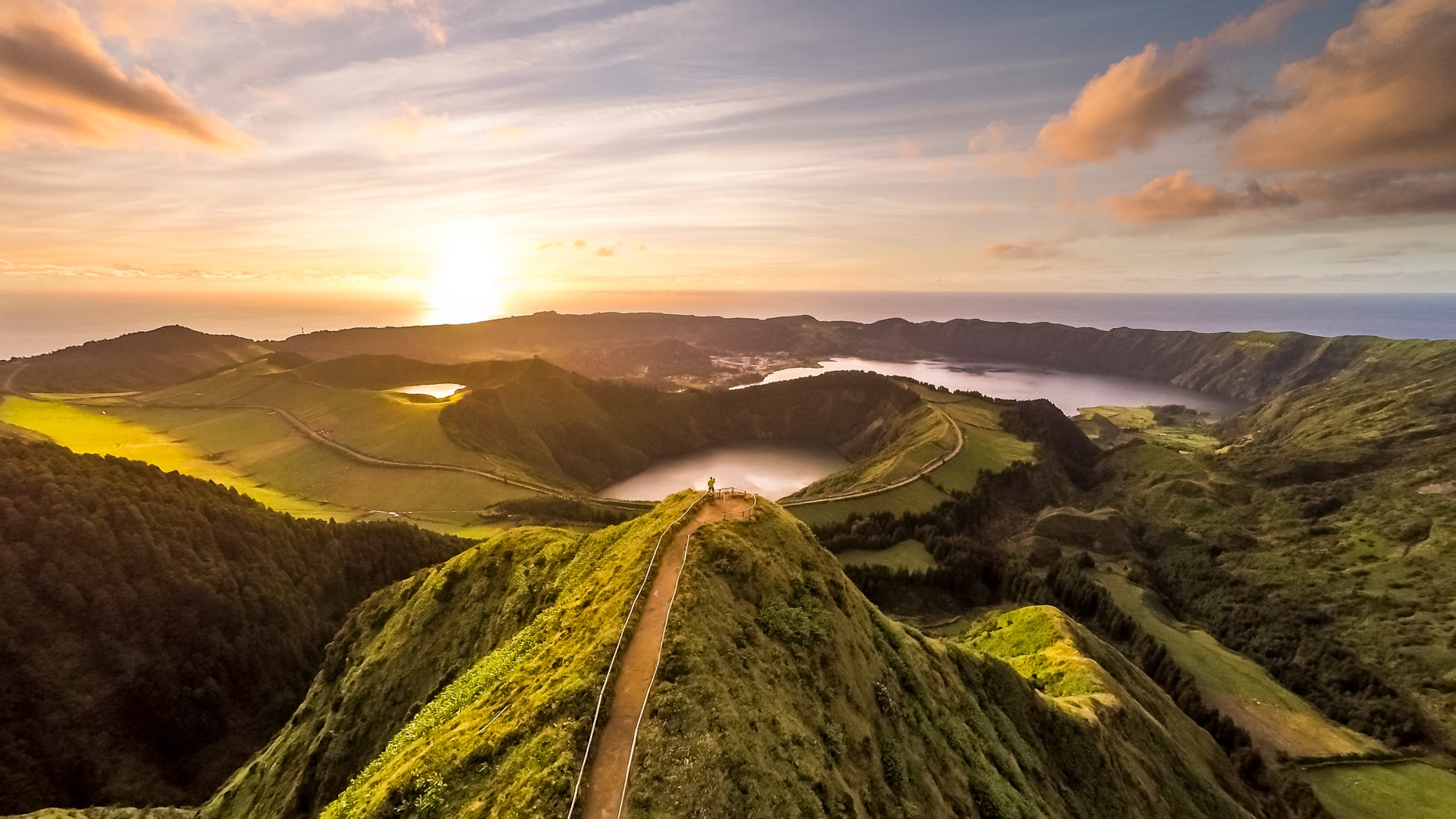
Most UK divers have never seriously considered the Azores, usually because they cannot place them on a map. Nine volcanic islands sit in the middle of the North Atlantic, roughly 1,400 km west of Lisbon, with thousands of metres of open ocean under the boat once you leave the shelf. That geography is the whole story: no reef, no lagoon, and animals that stop here because there is nothing else out there to stop at.
How far is it, and what does it cost you in travel time?
São Miguel, the largest island, takes direct summer flights from the UK at around four hours, and year-round routings through Lisbon with roughly two and a half hours on the second leg. The islands run one hour behind UK time, so there is no jet lag to sleep off, no long-haul fare and no vaccination list. Transfers from Ponta Delgada airport to the south-coast hotels are 10 to 40 minutes, and the hotel in town is barely ten of those.
What that buys is not a tropical week. It buys open Atlantic. Almost every one of the diving holidays in the Azores we arrange is based on São Miguel: it has the flights, and it has enough inshore diving and enough on land to hold a trip together when the offshore boats stay in.
When to go, and how short the window really is
Dive centres operate from roughly May to October, and the offshore season is narrower than the dive season. July, August and September are the months when the banks and the blue-water trips run with any regularity, with late June and early October as shoulders that sometimes deliver. From November to March most operators drop to weekend charters or close, and the exposed sites are undivable.
Wind direction shapes your day far more than rain. The south-coast harbours (Ponta Delgada, Caloura, Vila Franca do Campo) work in a northerly; a southerly puts swell straight into them, and a good centre moves you round the island rather than cancelling. Nobody can move you 60 km offshore in a 3-metre swell. Book a week, not a long weekend.
What the water temperature means for your suit
Approximate surface figures: around 16°C at the February and March low, 17 to 18°C in May, 19 to 20°C in June, 20 to 22°C in July, and 22 to 24°C through late August and September, which is as warm as it gets. October sits near 21°C. A thermocline of a couple of degrees below 20 to 30 metres is normal.
Our own team dives here in a 7 mm semi-dry with a hood. A 5 mm is enough in late August and September if you run warm and the dives are short, but not on an offshore day: nine hours on the water, two dives with a long interval between them, and wind chill in wet kit on both crossings. Pack gloves, and a windproof layer you do not mind ruining.
Which offshore trip, and from which island?
The Azores are ocean peaks, and some of the best diving is on the ones that never reached the surface. Submerged banks rise out of deep water, catch current and gather animals that have no other reason to stop. They are a long way out, only divable in settled weather, and no single island reaches all of them.
| Offshore trip | Leaves from | Boat time, each way | Best months | What you go for | Odds of it running |
|---|---|---|---|---|---|
| Princess Alice Bank | Horta (Faial) or Madalena (Pico) | About 3 hours | July to September | Mobula rays over a summit near 35 m | Low; expect several attempts |
| Formigas and Dollabarat | Ponta Delgada or Vila Franca do Campo (São Miguel) | 2 to 2.5 hours, or overnight | July to October | Schooling jacks, barracuda, big terrain | Low to moderate |
| Ambrósio | Vila do Porto (Santa Maria) | 35 to 40 minutes | July to September | Mobula rays over a reef topping out near 10 m | Moderate to good |
| Baited blue-water dive | São Miguel, Faial, Pico or Santa Maria | 1 to 2 hours | June to October | Blue sharks, occasionally makos | Moderate |
| Inshore day boats | Ponta Delgada or Caloura | 10 to 40 minutes | May to October | Wreck, arches, grouper, barracuda | Good, in season |
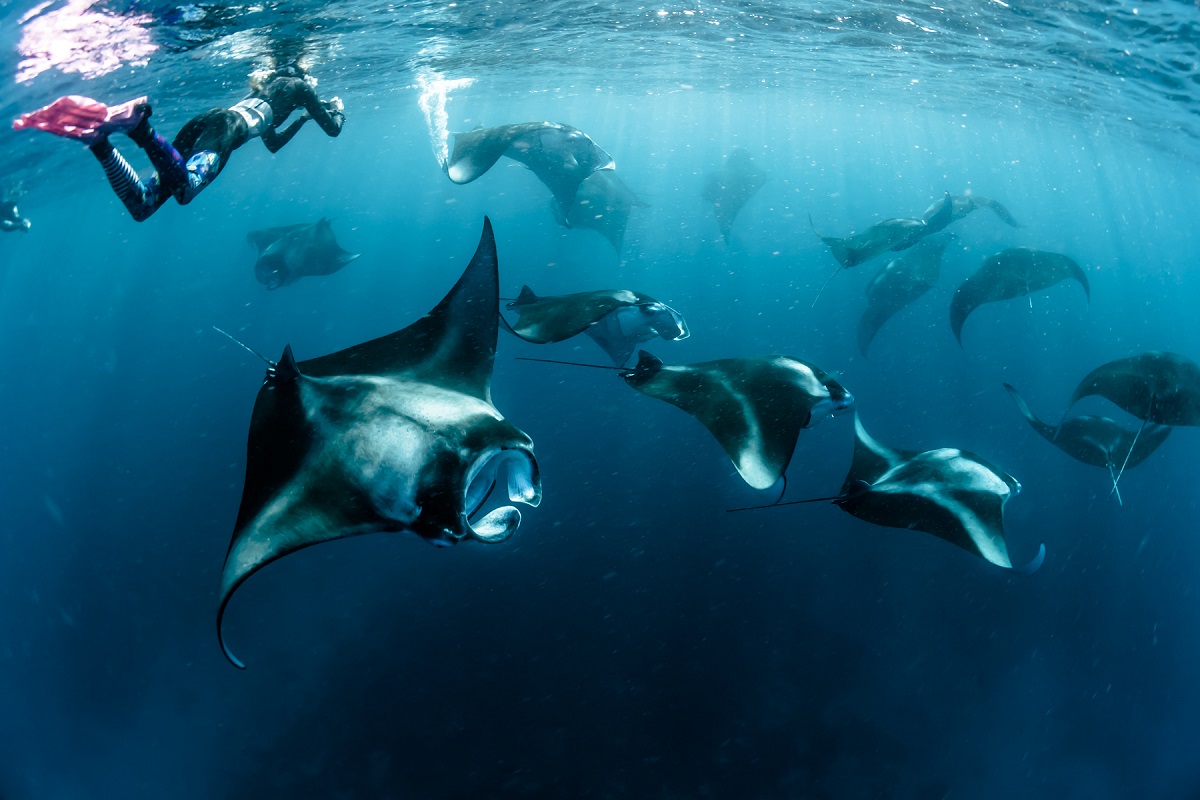
Princess Alice Bank is the one people have read about: roughly 80 km southwest of Faial, summit at about 35 metres. You do not dive the bank, you dive the water above it, hanging on a line in the blue while sicklefin devil rays (mobulas that run past three metres across, and close to 3.7 at the top end) rise to inspect the divers. In a settled July or August they come in dozens. Boats leave Horta on Faial or Madalena on Pico, not São Miguel — the misunderstanding we correct most often.
From São Miguel, the offshore equivalent is the Formigas islets and Dollabarat Bank, roughly 60 km southeast of the island inside a marine reserve: shallow ground falling away into deep water, with schooling fish in numbers you will not see inshore. Reckon on two and a half hours out of Ponta Delgada, a little under two from Vila Franca do Campo, run as a very long day or an overnight. Santa Maria, a short hop by air, has Ambrósio — a seamount three miles off the coast that tops out near 10 metres, with the devil rays circling in the shallow blue above it, and the least weather-dependent way to see them in the archipelago. If the rays are the whole point, say so when you enquire: Santa Maria bolts onto a São Miguel week easily enough, and Princess Alice does not.
What a baited blue-water dive is actually like
The shark dives work unlike anything most divers have done. The boat runs an hour or two out until the depth sounder stops meaning anything, sets a drift with a bait box and waits. Blue sharks are the reliable visitor, usually 1.5 to 2.5 metres, slim and inquisitive, and close enough that the problem becomes keeping them off your dome port. Shortfin makos appear perhaps one trip in several; they are faster and pushier, and a sensible skipper reads the group first.
You dive on a line under the boat, between about 5 and 15 metres, with no bottom and no visual reference. That is what it asks of you: buoyancy you do not think about, and the discipline to stay where the briefing put you. Most operators want a logged-dive count and recent open-water experience, and several run a check dive inshore before they will take you out, so ask when you book. Plenty of people do the same trip on a single breath, and a freediving holiday format suits the animals — no bubbles, and the sharks come shallower.
The wrecks and shore sites that carry the rest of the week
Inshore São Miguel is quieter diving, and it is what fills the logbook. The Dori, a wartime American Liberty ship that came to grief off the south coast in the 1960s, lies broken across roughly 10 to 20 metres a few minutes out of Ponta Delgada, shallow enough to spend an hour on. The Ilhéu de Vila Franca, a collapsed volcanic cone somewhere between five hundred metres and a kilometre off the south coast, forms a near-circular islet with a protected lagoon inside it; the diving is around the outside, on walls and boulder slopes holding dusky grouper, barracuda and ornate wrasse.
The rest is volcanic architecture: black basalt arches, swim-throughs, boulder fields and drop-offs, with algae instead of coral and a fish list closer to the Mediterranean than the tropics. Visibility inshore usually runs 15 to 25 metres, and better offshore. Nobody should come for the reef, but a week based on São Miguel gives you ten to fourteen dives you would happily repeat — which is exactly what matters on the days the banks are shut.
Whales, dolphins and the half of the trip that is not diving
The islands hunted sperm whales from open boats until the 1980s and now watch them instead. Sperm whales are resident year-round. Blue, fin and sei whales pass through between March and June, heading north out of the tropics towards the feeding grounds off Iceland, Greenland and Norway, with April and May strongest for blue whales, and common, bottlenose and Risso’s dolphins are resident rather than seasonal. More than twenty cetacean species have been recorded in Azorean waters.
Boats leave from Ponta Delgada and Vila Franca do Campo, many still working with cliff-top lookouts directing them by radio, left over from the whaling years. In-water swims run with dolphins under licence; whales are watched from the boat. On land, Furnas is the obvious day out: a valley of steaming ground where stew is cooked in volcanic soil, with thermal pools that are good after four days of diving. A night or two at Octant Hotel Furnas turns a blown-out day into somebody’s favourite part of the holiday.
Where to stay, and which side of the island
Which coast you sleep on decides how much of your week you spend in a van. Nearly all departures are from the south, and the drive down from the north coast is a little over twenty minutes each way on the fast road. That is not the barrier people imagine, but it is the best part of an hour of your day once you have done it twice, and the first half of it is before breakfast.
Hotel Caloura sits above its own small harbour on the south coast, minutes from where the boats go out, with sea access and very little else around it. It is the one we book most for divers who want the shortest possible morning.
Octant Ponta Delgada is in the capital, walking distance from the marina and from somewhere to eat that is not the hotel restaurant. That counts for more than it sounds when you are up at six and back at four, and it is the easiest base if one of you is not diving.
The Santa Bárbara Eco Beach Resort we recommend with a caveat attached, not a warning. It is on the north coast above a black-sand surf beach, and it is the nicest place on the island to sit still. The caveat is the twenty-odd minutes over the ridge to the harbours, twice a day, which is a fair trade if you want the beach and the space and a poor one if you want to roll out of bed onto the boat. It works well as the back half of a split week, or when only one of you is in the water.
Who this isn’t for
If a diving holiday means 28°C water, a soft-coral wall and four dives a day that always happen, do not book the Azores. This is cool, green-blue temperate Atlantic diving over volcanic rock. There is no coral, the fish list is shorter than the Red Sea’s, and every day is arranged around a forecast. On an hour less in the air, Malta gives you clear summer water, wrecks and shore diving you can do on your own schedule.
It is the wrong trip, too, if you are travelling for one animal in one fixed week and would count the holiday a failure without it. The rays and the sharks are seasonal, not scheduled. We have seen a week with four offshore days and a week with none, in the same August. If your leave is inflexible and a cancelled boat would sour the trip, a Mediterranean summer in Italy will treat you more kindly. If it is only the devil rays you cannot go home without, the fix is usually a longer window and a few nights on Santa Maria rather than a different country, and that is a conversation worth having before you book flights.
And if you have thirty dives, all of them behind a guide on a reef in warm water, an offshore blue-water trip is not the place to learn how you handle no bottom and no reference. Build the dives up inshore first, here or anywhere else.
Who it does suit: divers with a reasonable logbook who want large animals in cold-ish open ocean, who would call two good offshore days out of six a good week, and who like the land half of a trip as much as the water. Come in late July or August, give it a full week, and count every morning the boat leaves the harbour as the win.
Frequently asked questions
Can you dive Princess Alice Bank from São Miguel?
No. Princess Alice sits roughly 80 km southwest of Faial, and the trips leave from Horta on Faial or Madalena on Pico, around three hours each way. From São Miguel the offshore equivalent is the Formigas islets and Dollabarat Bank, roughly 60 km southeast of the island inside a marine reserve, run as a very long day or an overnight when the forecast allows. If devil rays rather than the bank itself are the reason you are going, the option that adds to a São Miguel week is Ambrósio off Santa Maria, a short flight away. Tell us which of the two you actually want and we will build the week around it.
How cold is the water for diving in the Azores?
Approximate surface temperatures: around 16C at the February and March low, 17 to 18C in May, 19 to 20C in June, 20 to 22C in July, and 22 to 24C through late August and September. October holds near 21C. A 7mm semi-dry with a hood is the sensible default; 5mm works in late summer on short dives. Offshore days mean hours of wind chill in wet kit, so overdress rather than under.
What sharks can you see diving in the Azores?
Blue sharks, mostly, on baited dives in open water between June and October. They usually run 1.5 to 2.5 metres and come close. Shortfin makos turn up on a minority of trips and are handled more carefully by skippers. These are not reef sharks on a reef: you hang on a line under the boat at 5 to 15 metres with several hundred metres of water below you.
How many dives do you need before diving the Azores?
The inshore sites around São Miguel suit anyone qualified and reasonably current. The offshore trips are different. Most operators want a logged-dive count, recent experience and buoyancy you do not have to think about, because blue water gives you no bottom and no reference. Several also run a check dive at a coastal site first, and some set an advanced or deep qualification for the deeper bank dives. Ask the centre directly before you book flights.
What happens if the weather cancels the offshore diving?
It happens often enough that you should plan for it. Centres usually move you to sheltered inshore sites on the other side of the island, or refund the offshore day. That is one reason we base most trips on São Miguel: the Dori wreck, the Vila Franca islet and the volcanic sites fill the week, and whale watching, the Furnas thermal valley and the crater lakes cover the rest.
Planning an Azores dive week around the weather
Tell us when you can travel, how many dives you have logged and whether the mobula rays are the point. We will tell you which island to base on, how many offshore days to budget for, and which crossings are worth it.
Free, with no obligation and no booking fee. We’re a UK dive tour operator, trading since 2001 —
every resort and liveaboard we sell has been dived by one of our own team. Mon–Fri, 09:00–18:00 UK ·
ATOL protected (T7314) and Travel Trust Association members.